Subscribe to our ▶️ YouTube channel 🔴 for the latest videos, updates, and tips.
Worksheet on Reducing Fraction
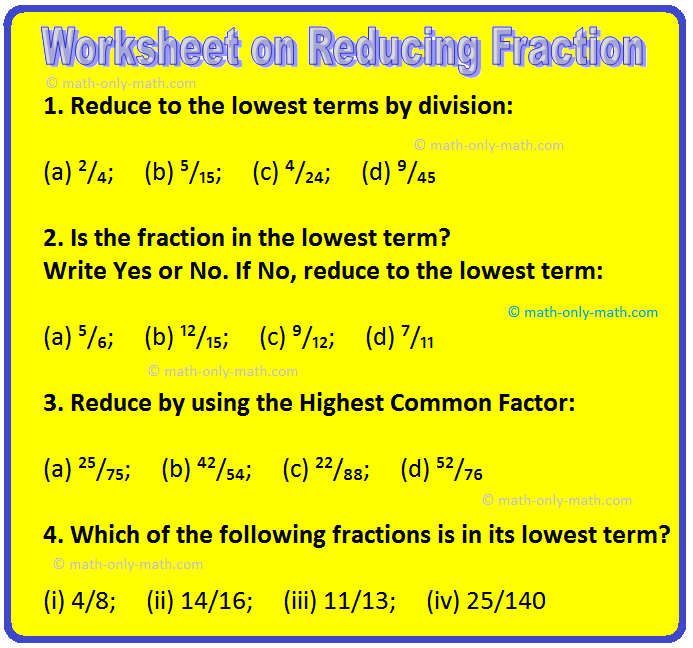
Practice the questions given in the math worksheet on reducing fraction to the lowest terms by using division. Fractional numbers are given in the questions to reduce to its lowest term.
1. Reduce to the lowest terms by division:
(a) \(\frac{2}{4}\)
(b) \(\frac{5}{15}\)
(c) \(\frac{4}{24}\)
(d) \(\frac{9}{45}\)
(e) \(\frac{7}{28}\)
(f) \(\frac{9}{30}\)
(g) \(\frac{8}{40}\)
(h) \(\frac{25}{50}\)
2. Is the fraction in the lowest term?
Write Yes or No. If No, reduce to the lowest term:
(a) \(\frac{5}{6}\)
(b) \(\frac{12}{15}\)
(c) \(\frac{9}{12}\)
(d) \(\frac{7}{11}\)
(e) \(\frac{8}{9}\)
(f) \(\frac{12}{14}\)
(g) \(\frac{6}{8}\)
(h) \(\frac{8}{13}\)
3. Reduce by using the Highest Common Factor:
(a) \(\frac{25}{75}\)
(b) \(\frac{42}{54}\)
(c) \(\frac{22}{88}\)
(d) \(\frac{52}{76}\)
(e) \(\frac{75}{100}\)
(f) \(\frac{96}{108}\)
(g) \(\frac{52}{68}\)
(h) \(\frac{72}{90}\)
4. Which of the following fractions is in its lowest term?
(i) \(\frac{4}{8}\)
(ii) \(\frac{14}{16}\)
(ⅲ) \(\frac{11}{13}\)
(iv) \(\frac{25}{140}\)
5. Reduce each of the following fractions in its lowest term:
(i) \(\frac{14}{42}\)
(ii) \(\frac{45}{65}\)
(iii) \(\frac{108}{220}\)
(iv) \(\frac{132}{264}\)
(v) \(\frac{78}{520}\)
(vi) \(\frac{182}{32}\)
(vii) \(\frac{140}{235}\)
(viii) \(\frac{242}{432}\)
6. Write each fraction in its lowest terms:
(i) \(\frac{36}{81}\)
(ii) \(\frac{60}{45}\)
(iii) \(\frac{500}{175}\)
(iv) \(\frac{46}{69}\)
(v) \(\frac{240}{400}\)
7. Show that each of the following fractions is in its simplest form:
(i) \(\frac{3}{25}\)
(ii) \(\frac{9}{19}\)
(iii) \(\frac{17}{27}\)
8. The simplest form of \(\frac{18}{114}\) is
(a) \(\frac{7}{12}\); (b) \(\frac{3}{19}\); (c) \(\frac{3}{7}\); (d) \(\frac{7}{19}\)
Answers for the worksheet on reducing fraction to the lowest terms are given below to check the exact answers of the above questions.
Answers:
1. (a) \(\frac{1}{2}\)
(b) \(\frac{1}{3}\)
(c) \(\frac{1}{6}\)
(d) \(\frac{1}{5}\)
(e) \(\frac{1}{4}\)
(f) \(\frac{3}{10}\)
(g) \(\frac{1}{5}\)
(h) \(\frac{1}{2}\)
2. (a) Yes
(b) No, \(\frac{4}{5}\)
(c) No, \(\frac{3}{4}\)
(d) Yes
(e) Yes
(f) No, \(\frac{6}{7}\)
(g) No, \(\frac{3}{4}\)
(h) Yes
3. (a) \(\frac{1}{3}\)
(b) \(\frac{7}{9}\)
(c) \(\frac{1}{4}\)
(d) \(\frac{13}{19}\)
(e) \(\frac{3}{4}\)
(f) \(\frac{8}{9}\)
(g) \(\frac{13}{17}\)
(h) \(\frac{4}{5}\)
4. (i) \(\frac{1}{2}\)
(ii) \(\frac{7}{8}\)
(ⅲ) \(\frac{11}{13}\)
(iv) \(\frac{5}{28}\)
5. (i) \(\frac{1}{3}\)
(ii) \(\frac{9}{13}\)
(iii) \(\frac{27}{55}\)
(iv) \(\frac{1}{2}\)
(v) \(\frac{3}{20}\)
(vi) \(\frac{91}{16}\)
(vii) \(\frac{28}{47}\)
(viii) \(\frac{121}{216}\)
6. (i) \(\frac{4}{9}\)
(ii) \(\frac{4}{3}\)
(iii) \(\frac{20}{7}\)
(iv) \(\frac{2}{3}\)
(v) \(\frac{3}{5}\)
8. (b) \(\frac{3}{19}\)
● Fractional Numbers - worksheets
Worksheet on Equivalent Fractions.
Worksheet on Comparison of Like Fractions.
Worksheet on Conversion of Fractions.
Worksheet on Changing Fractions.
Worksheet on Types of Fractions.
Worksheet on Reducing Fraction.
Worksheet on Addition of Fractions having the Same Denominator.
Worksheet on Subtraction of Fractions having the Same Denominator.
Worksheet on Add and Subtract Fractions.
Worksheet on Fractional Numbers.
From Worksheet on Reducing Fraction to HOME PAGE
Didn't find what you were looking for? Or want to know more information about Math Only Math. Use this Google Search to find what you need.


