Subscribe to our ▶️ YouTube channel 🔴 for the latest videos, updates, and tips.
Worksheet on Roman Numerals
This Roman Numerals Worksheet provides students with a variety of exercises to practice reading, writing, comparing, and converting Roman numerals. Roman numerals use symbols such as I, V, X, L, C, D, and M to represent numbers. Students can practice converting Hindu-Arabic numbers into Roman numerals and Roman numerals into Hindu-Arabic numbers. The worksheet also includes questions on Roman numeral rules, ordering numbers, identifying incorrect numerals, comparing values, solving simple operations, and working with larger Roman numbers. These Roman numerals exercises are suitable for elementary and middle-school students and can be used for classroom practice, homework, revision, or assessment. An answer key is included so students, parents, and teachers can quickly check the solutions.
What Are Roman Numerals?
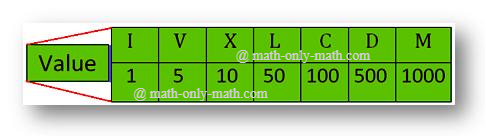
Roman numerals are a number system that uses letters to represent numbers. The seven basic Roman numeral symbols are I, V, X, L, C, D, and M, which represent 1, 5, 10, 50, 100, 500, and 1,000 respectively. Roman numerals are written by combining these symbols according to specific rules.
For example: III = 3, VIII = 8, IX = 9, and XIV = 14.
Roman numerals are still used today in clocks, book chapters, outlines, movie titles, and special events. Learning Roman numerals helps students understand number representation, addition and subtraction rules, and how different number systems work.
Roman Numeral Symbols:
Rules for Writing Roman Numerals:
Rule I:
When a symbol is repeated it means the value of each symbol is added. The sum is equal to the number formed.
For example: III = 1 + 1 + 1 = 3,
XX = 10 + 10 = 20
XXX = 10 + 10 + 10 = 30
Note: V, L, and D cannot be repeated
Rule II:
When a symbol with a smaller value is written before a symbol having a greater value, it means the value of the first symbol is subtracted from the value of the second symbol.
For example: IV = 5 - 1 = 4
IX = 10 - 1 = 9
Rule III:
When a symbol with a smaller value is written after a symbol having a greater value, it means the value of the first symbol is added to the value of the second symbol.
For example: XI = 10 + 1 = 11
VI = 5 + 1 = 6
XIII = 10 + 1 + 1 + 1 = 13
Rule IV:
For expressing numbers greater than 10, the numbers are first split in terms of tens and ones.
For example:
12 = 10 + 2 = XII
18 = 10 + 5 + 3 = XVIII
29 = 10 + 10 + 9 = XXIX
35 = 10 + 10 + 10 + 5 = XXXV
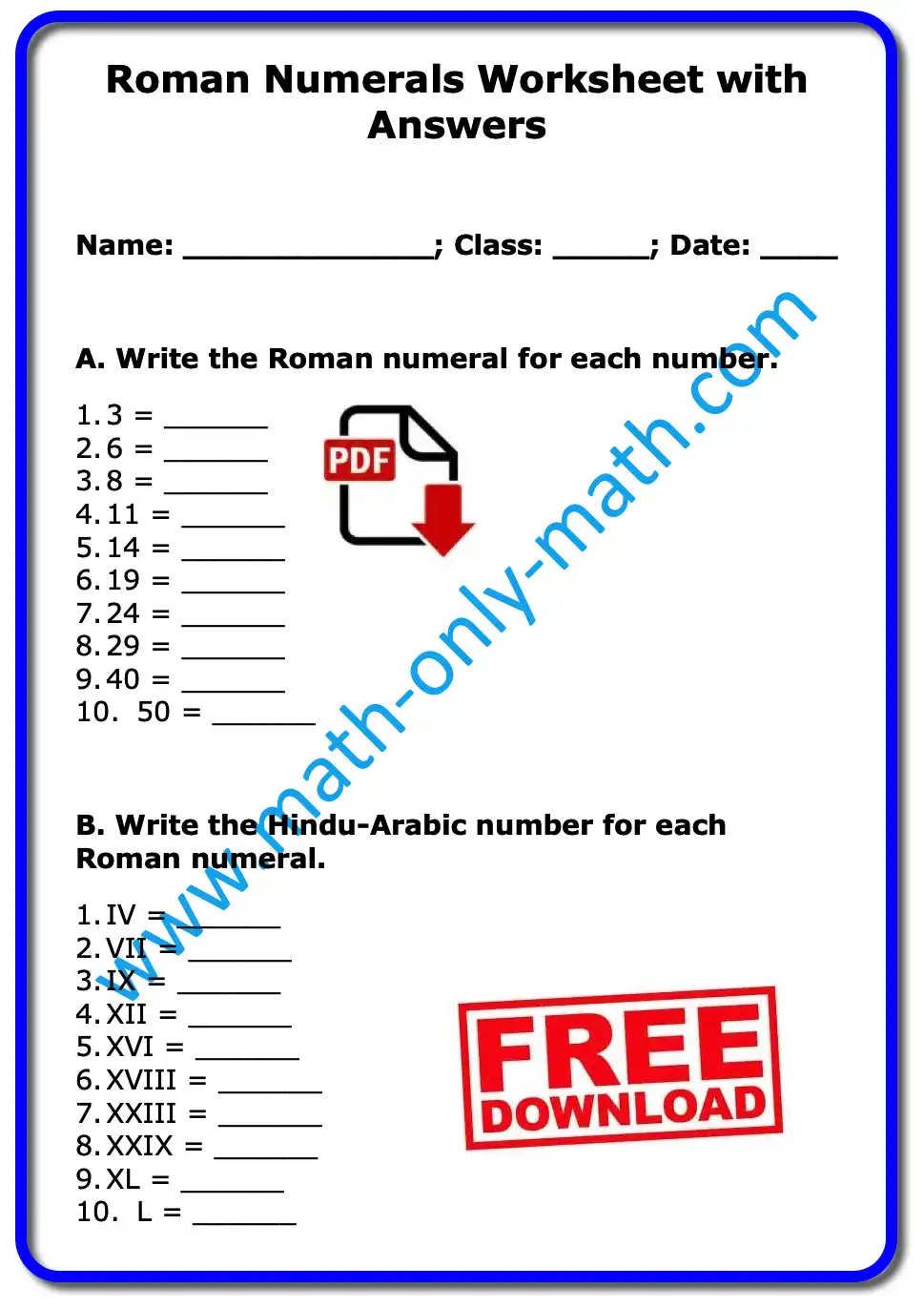
Roman Numerals Worksheet:

Roman Numerals Practice Questions:
Before practicing, learn more about Roman Numerals and their rules.
Students can also practice Roman Numeration with additional conversion and comparison exercises.
1. Write the Roman Numerals for the following numbers:
|
(a) 6 (b) 17 (c) 28 (d) 24 |
(e) 18 (f) 22 (g) 29 (h) 30 |
2. Write the roman numerals for each of the following Hindu -Arabic numerals.
|
(a) 3 (b) 11 (c) 7 (d) 26 |
(e) 8 (f) 35 (g) 9 (h) 39 |
3. Write each of the following in a Roman numeral:
(i) 31
(ii) 14
(iii) 23
(iv) 11
(v) 25
(vi) 27
(vii) 37
(viii) 32
(ix) 19
(x) 30
(xi) 39
(xii) 12
(xiii) 17
(xiv) 15
(xv) 33
4. Write the number for the following:
|
(a) VII (b) IX (c) XI (d) XIV |
(e) XIX (f) XXVII (g) XXIX (h) XII |
5. Write the Hindu-Arabic numerals for each of the following Roman numerals:
|
(a) V (b) XVII (c) IV (d) XIX |
(e) XV (f) XXVIII (g) XXXIV (h) XVIII |
6. Write the Hindu-Arabic numeral for each of the following:
(i) IV
(ii) IX
(iii) XVI
(iv) XVII
(v) XX
(vi) XXVIII
(vii) XIX
(viii) XV
(ix) XXXIV
(x) XXXVII
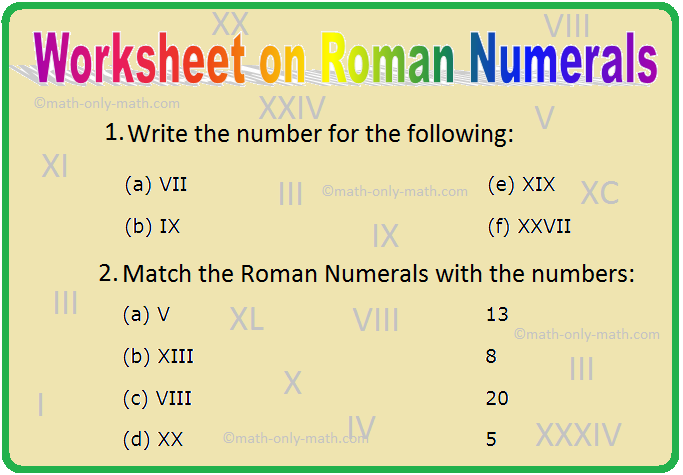
7. Match the Roman Numerals with the numbers:
|
(a) V (b) XIII (c) VIII (d) XX (e) XXII (f) XXV (g) XI |
13 8 20 5 25 22 11 |
8. Match the given Roman numerals to the Hindu-Arabic numerals.
|
(a) CXIX (b) XL (c) CLXXV (d) XCVIII (e) XXXVII (f) LIV |
37 175 98 54 119 40 |
9. Arrange the given Roman numerals in ascending order.
(a) VII, II, XIV, X
(b) VI, IX, III, VIII
10. Circle the greatest Roman Numerals in each row.
|
(a) (b) (c) (d) (e) (f) (g) |
X VII XLII XXXVII XVIII CXX CLXII |
IX IV LIII XXXII LXIV CL CXLII |
XII VIII LXXI XXXV LX XC XCV |
XIV V XLVII XXXI LXIII CXXX CLVII |
11. Tick the correct Roman Numerals for numbers:
(a) 24
XIV XXIV XV
(b) 17
VII XII XVII
(c) 14
XIV XVI XV
(d) 29
XIX XX XXIX
12. Which of the given Roman numerals are not possible? Circle your answer.
|
(a) III (b) VIIII (c) XIV (d) XIIV (e) XXL |
(f) LXIX (g) XXC (h) CIIX (i) CLXX (j) CLIIIX |
13. Use the symbols > = < in the correct places:
(a) 27 ___ XX
(b) XV ___ IX
(c) 19 ___ XIX
(d) XV ___ 14
(e) V ___ 12
(f) 29 ___ XXX
14. Fill in each box using <, = or>:
(i) XIX _____ 21
(ii) XXXIX _____ 39
(iii) XI _____ 9
15. Which of the following are meaningless?
(i) XIII
(ii) XIX
(iii) XVV
(iv) XXV
(v) VX
16. Perform the operation mentioned and write the answers in Roman Numerals:
(a) XI × V = _________
(b) XXV ÷ V = _________
(c) VIII ÷ II = _________
(d) VII + XXIII = _________
(e) XXX – XXI = _________
(f) XXI - XX = _________
17. Mike forgot the rule while writing Roman Numerals. Help him by drawing a circle around the incorrect Roman Numeral and write the correct Roman numeral beside each incorrect representation:
(a) 15 = VVV
(b) 24 = XXVI
(c) 8 = IIX
(d) 19 = XVIIII
(e) 25 = XXVX
(f) 17 = IIIXX
18. Write the roman numbers and their values from I to XXV:
19. Choose the right answer:
(i) The greatest numeral in the given set is:
(a) XXXV; (b) XXIX; (c) XLIV; (d) LX
(ii) The smallest numeral in the given set is:
(a) C; (b) V; (c) L; (d) X
(iii) The number of days in the month of October are:
(a) XXVIII; (b) XXXI; (c) XXXIV; (d) X
(iv) Number of years in a century:
(a) X; (b) L; (c) C; (d) CC
(v) Number of weeks in a year:
(a) LII; (b) XXIV; (c) XXXVI; (d) L
20. Choose the right answer and fill in the blank.
(i) There are __________ number of days in January.
(a) XXVIII; (b) XXXI; (c) XXIX; (d) XXX
(ii) Numeral CLV is __________ CXLV.
(a) Smaller than; (b) Greater than; (c) Equal to
(iii) Numeral XVIII is __________ to XVI.
(a) Smaller than; (b) Greater than; (c) Equal to
(iv) There are total of __________ letters in the word Mathematics.
(a) XI; (b) XII; (c) XX; (d) XXX
21. Circle the correct Roman numeral:
(i) 7 - VIII VII VI
(ii) 13 - XII XIII XIV
(iii) 21 - XX XXI XIX
(iv) 20 - XX XVV XIX
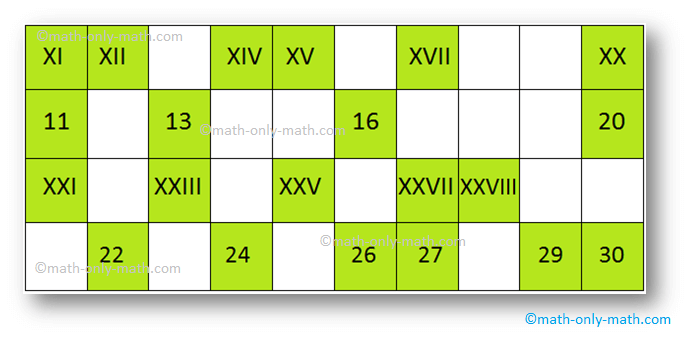
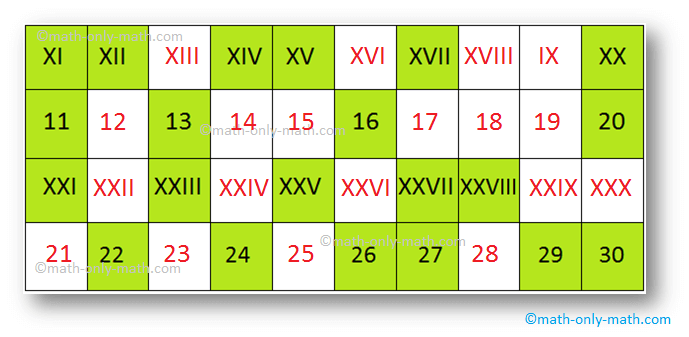
22. Complete the table:
23. Choose the right answer.
A. In a garden there are 11 non-flowering plants and 13 flowering plants. The total number of plants in the garden are:
(i) XIV (ii) XXIV (iii) XX (iv) XXX
B. The smallest numeral among the following numerals is:
(i) VI (ii) VII (iii) XXVI (iv) XXX
C. The number of hours in a day are:
(i) XXIV (ii) XII (iii) XVI (iv) XXXIV
D. Which Roman numeral represents 4?
(i) XI (ii) VI (iii) IV (iv) VII
E. What should be subtracted from XXXIX to get IX?
(i) X (ii) XXx (iii) XXI (iv) IX
F. The greatest numeral among the following numerals is:
(i) XXXII (ii) XXX (iii) XXIX (iv) IX
G. Smallest even number is:
(i) I (ii) II (iii) III (iv) IV
24. Complete the series:
XXIV, XXV, _____, _____, _____.
25. Which two letters from the English word ELEVEN can be used in the Roman numerals?
26. Match the following:
|
L |
50 |
|
C |
500 |
|
D |
100 |
|
M |
1000 |
27. Multiple Choice Questions (MCQ's)
Choose the correct option
(i) Which of the following statements about Roman numerals is incorrect?
(a) 10 ≠ VV; (b) 51 = IL; (c) 5 ≠ VX; (d) All of the above
(ii) XLVII stands for
(a) 44; (b) 68; (c) 72; (d) 47
(iii) Hindu-Arabic numeral for 27 is __________.
(a) XXV; (b) XXVII; (c) XVII
(iv) XXIX is equal to:
(a) 27; (b) 28; (c) 29
(v) Which of the following is the greatest?
(a) X; (b) XIX; (c) XVIII
(vi) Which is not the Roman symbol?
(a) P; (b) L; (c) X
(vii) XII - IX = _____.
(a) II; (b) IV; (c) III
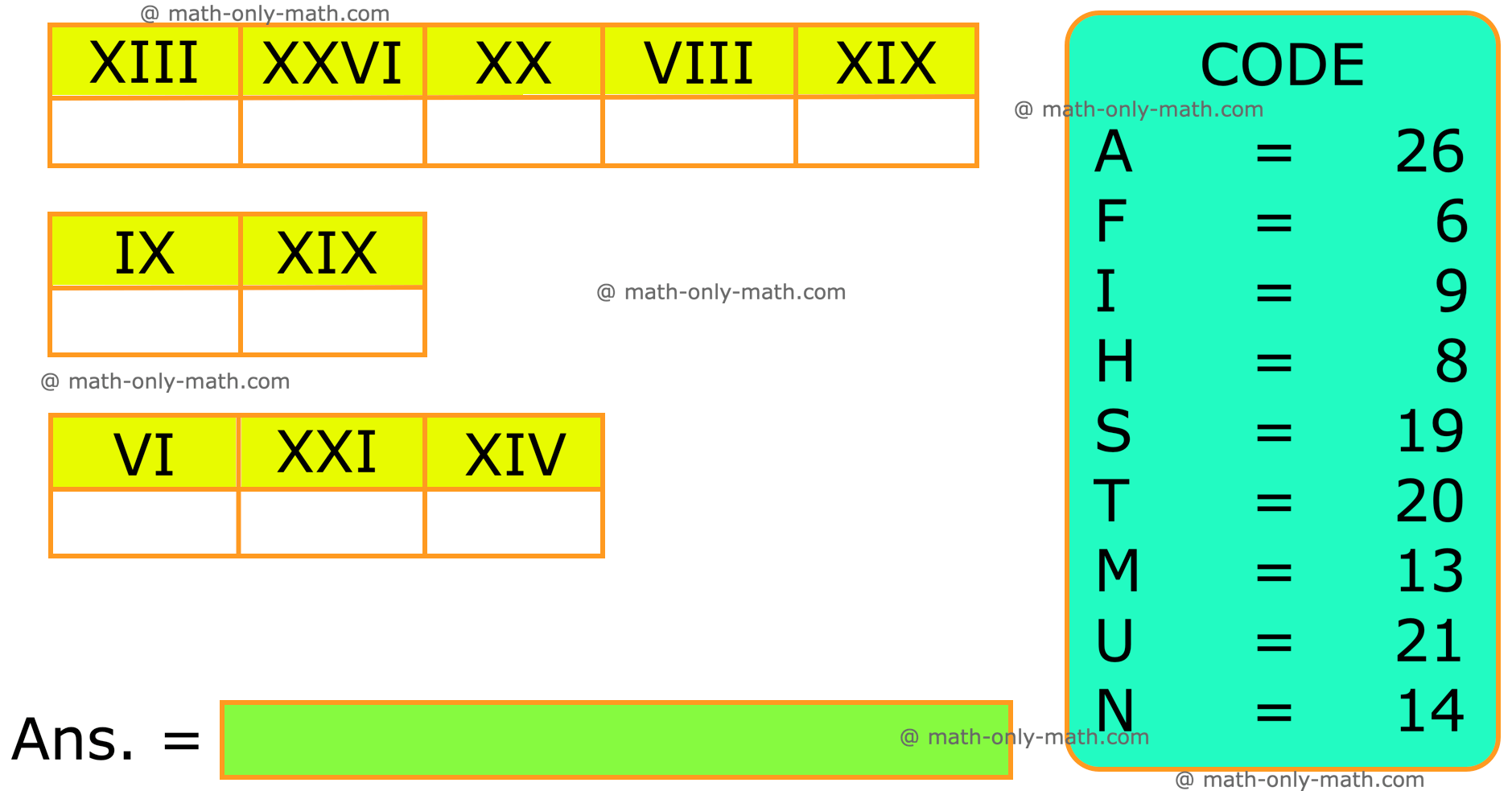
28. Read the message by decoding the Roman numeral.
Rule: First change the numerals into Hindu-Arabic numbers, then find the alphabet letter that matches each numeral.
Play Roman Numerals Drag and Drop Game:
Roman Numerals Drag & Drop
Drag the correct Roman numeral into the answer box.
Game Complete!
| # | Number | Your Answer | Correct Answer | Result |
|---|
Larger Roman Numbers
29. Convert into Roman numbers.
|
(i) 415 (ii) 1110 (iii) 3200 (iv) 920 (v) 1240 (vi) 1940 (vii) 1220 (viii) 2400 (ix) 1390 (x) 2250 |
(xi) 1450 (xii) 2410 (xiii) 3450 (xiv) 2650 (xv) 1910 (xvi) 3610 (xvii) 1900 (xviii) 1650 (xix) 1607 (xx) 2543 |
30. Convert into Hindu-Arabic numbers.
|
1. LXVI 2. MMCC 3. MCXII 4. MMD 5. XLVII 6. CCIV 7. MDCIX 8. DLVII 9 CCCXI 10. DCVII |
11. MMMXX 12. MMCX 13. MCDXC 14. CCCXIV 15. CMXLV 16. MDCXVI 17. MCCXX 18. MMCXIV 19. CCCXIII 20. DXC |
31. Nairitee was asked to convert the roman numerals MCMXVIII into Hindu-Arabic number. She converted MCMXVIII as 1000 + 100 + 1000 + 10 + 5 + 1 + 1 + 1 = 2118. Is her answer correct? If not, what should be the correct answer?
32. Some of the following numbers are represented wrongly. Identify them.
1. CX
2. LLLL
3. MCM
4. MMMM
5. CCCC
6. CCXCXI
7. XIIII
8. VVVII
Roman Number Calculator:
Roman Numeral Converter
Convert Roman numerals and Hindu-Arabic numerals easily.
Use standard Roman numerals from I to MMMCMXCIX.
Enter a whole number from 1 to 3,999.
Answers for the worksheet on roman numerals are given below to check the exact answers of the above questions.
Answers:
1. (a) VI
(b) XVII
(c) XXVIII
(d) XXIV
(e) XVIII
(f) XXII
(g) XXIX
(h) XXX
2.
|
(a) III (b) XI (c) VII (d) XXVI |
(e) VIII (f) XXXV (g) IX (h) XXXIX |
3. (i) XXXI
(ii) XIV
(iii) XXIII
(iv) XI
(v) XXV
(vi) XXVII
(vii) XXXVII
(viii) XXXII
(ix) XIX
(x) XXX
(xi) XXXIX
(xii) XII
(xiii) XVII
(xiv) XV
(xv) XXXIII
4.
|
(a) 7 (b) 9 (c) 11 (d) 14 |
(e) 19 (f) 28 (g) 29 (h) 12 |
5.
|
(a) 5 (b) 17 (c) 4 (d) 19 |
(e) 15 (f) 28 (g) 34 (h) 18 |
6. (i) 4
(ii) 9
(iii) 16
(iv) 17
(v) 20
(vi) 28
(vii) 19
(viii) 15
(ix) 34
(x) 37
7.
|
(a) V (b) XIII (c) VIII (d) XX (e) XXII (f) XXV (g) XI |
5 13 8 20 22 25 11 |
8.
|
(a) CXIX (b) XL (c) CLXXV (d) XCVIII (e) XXXVII (f) LIV |
119 40 175 98 37 54 |
9. (a) II, VII, X, XIV
(b) III, VI, VIII, IX
10. (a) XIV
(b) VIII
(C) LXXI
(d) XXXVII
(e) LXIV
(f) CL
(g) CLXII
11. (a) XXIV
(b) XVII
(c) XIV
(d) XXIX
12. (b) VIIII
(d) XIIV
(e) XXL
(g) XXC
(h) CIIX
13. (a) >
(b) >
(c) =
(d) <
(e) =
(f) <
14. (i) <
(ii) =
(iii) >
15. (iii) XVV
(v) VX
16. (a) LV
(b) V
(c) IV
(d) XXX
(e) IX
(f) I
17. (a) XV
(b) XXIV
(c) VIII
(d) XIX
(e) XXV
(f) XVII
18. Roman Numbers and their Values
|
1 - I 2 - II 3 - III 4 - IV 5 - V |
6 - VI 7 - VII 8 - VIII 9 - IX 10 - X |
11 - XI 12 - XII 13 - XIII 14 - XIV 15 - XV |
16 - XVI 17 - XVII 18 - XVIII 19 - XIX 20 - XX |
21 - XXI 22 - XXII 23 - XXIII 24 - XXIV 25 - XXV |
19. (i) → (d)
(ii) → (b)
(iii) → (b)
(iv) → (c)
(v) → (a)
20. (i) → (b)
(ii) → (b)
(iii) → (b)
(iv) → (a)
21. (i) VIII
(ii) XIII
(iii) XXI
(iv) XX
22.
23. A. (ii)
B. (i)
C. (i)
D. (iii)
E. (ii)
F. (i)
G. (ii)
24. XXVI, XXVII, XXVIII
25. X and I, because 11 = XI.
26. L - 50
C - 100
D - 500
M - 1000
27. (i) → (d) All of the above
(ii) → (d) 47
(iii) → (b) XXVII
(iv) → (c) 29
(v) → (b) XIX
(vi) → (a) P
(vii) → (c) III
28. MATHS IS FUN
29.
|
(i) CDXV (ii) MCX (iii) MMMCC (iv) CMXX (v) MCCXL (vi) MCMXL (vii) MCCXX (viii) MMCD (ix) MCCCXC (x) MMCCL |
(xi) MCDL (xii) MMCDX (xiii) MMMCDL (xiv) MMDCL (xv) MCMX (xvi) MMMDCX (vii) MCM (xviii) MDCL (xix) MDCVII (xx) MMDXLIII |
30.
|
(i) 66 (ii) 2200 (iii) 1112 (iv) 2500 (v) 47 (vi) 204 (vii) 1609 (viii) 557 (ix) 311 (x) 607 |
(xi) 3020 (xii) 2110 (xiii) 1490 (xiv) 314 (xv) 945 (xvi) 1616 (xvii) 1220 (xviii) 2114 (xix) 313 (xx) 590 |
31. No; 1918
32. (ii) LLLL
(iv) MMMM
(v) CCCC
(vii) XIIII
(viii) VVVII
Play Roman Numerals Quiz:
Roman Numerals Quiz
Choose the correct answer for each question.
🎉 Quiz Complete!
Frequently Asked Questions (FAQs) on Roman Numerals:
1. What are Roman numerals?
1. What are Roman numerals?
Answer:
Roman numerals are a number system that uses letters to represent numbers. The seven basic symbols are I, V, X, L, C, D, and M, representing 1, 5, 10, 50, 100, 500, and 1,000.
2. What are the seven basic Roman numeral symbols?
2. What are the seven basic Roman numeral symbols?
Answer:
The seven basic Roman numeral symbols are I = 1, V = 5, X = 10, L = 50, C = 100, D = 500, and M = 1,000. These symbols are combined to write different numbers.
3. How do you write numbers in Roman numerals?
3. How do you write numbers in Roman numerals?
Answer:
To write a number in Roman numerals, break the number into its place values and represent each value using Roman numeral symbols. For example, 26 = XXVI, because 20 is XX and 6 is VI.
4. How do you convert Roman numerals into numbers?
4. How do you convert Roman numerals into numbers?
Answer:
To convert a Roman numeral into a number, read the symbols and apply the addition or subtraction rules. For example, XVI = 16 because X = 10, V = 5, and I = 1.
5. What are Roman numeral rules?
5. What are Roman numeral rules?
Answer:
Roman numerals follow rules for combining symbols. A symbol is usually added when it comes after a symbol of equal or greater value. In certain combinations, a smaller symbol before a larger one indicates subtraction, such as IV = 4 and IX = 9.
6. Where are Roman numerals used today?
6. Where are Roman numerals used today?
Answer:
Roman numerals are still used in many places, including clock faces, book chapters, movie titles, historical names, outlines, and special events. They are also commonly used to number sections or editions.
7. What is 4 in Roman numerals?
7. What is 4 in Roman numerals?
Answer:
The Roman numeral for 4 is IV. The symbol I comes before V, so 1 is subtracted from 5: 5 - 1 = 4.
8. What is 9 in Roman numerals?
8. What is 9 in Roman numerals?
Answer:
The Roman numeral for 9 is IX. Here, I comes before X, so 1 is subtracted from 10: 10 - 1 = 9.
9. Why should students learn Roman numerals?
9. Why should students learn Roman numerals?
Answer:
Learning Roman numerals helps students understand another way of representing numbers. It also strengthens their understanding of number values, addition, subtraction, patterns, and mathematical symbols.
10. How can I practice Roman numerals?
10. How can I practice Roman numerals?
Answer:
Students can practice by converting numbers to Roman numerals, converting Roman numerals to numbers, comparing values, arranging numerals in order, and identifying correctly written Roman numerals. A Roman Numerals Worksheet with Answers provides useful practice for these skills.
About Author

Written by Priyanka Ghosh
Mathematics Educator | Founder of Math Only Math
Priyanka Ghosh has been teaching elementary and middle-school mathematics for over 12 years and specializes in creating simple, child-friendly math lessons and worksheets.
From Worksheet on Roman Numerals to HOME PAGE
Didn't find what you were looking for? Or want to know more information about Math Only Math. Use this Google Search to find what you need.



