Subscribe to our ▶️ YouTube channel 🔴 for the latest videos, updates, and tips.
√2 cos x - 1 = 0
We will discuss about the general solution of the equation square root of 2 cos x minus 1 equals 0 (i.e., √2 cos x - 1 = 0) or cos x equals 1 by square root of 2 (i.e., cos x = \(\frac{1}{√2}\)).
How to find the general solution of the trigonometric equation cos x = \(\frac{1}{√2}\) or √2 cos x - 1 = 0?
Solution:
We have,
√2 cos x - 1 = 0
⇒ √2 cos x = 1
⇒ cos x = \(\frac{1}{√2}\)
⇒ cos x = cos \(\frac{π}{4}\) or, cos (- \(\frac{π}{4}\))
Let O be the centre of a unit circle. We know that in unit
circle, the length of the circumference is 2π.
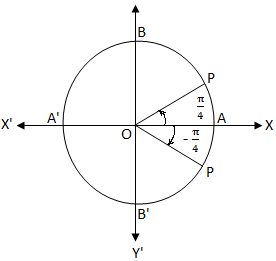
If we started from A and moves in anticlockwise direction then at the points A, B, A', B' and A, the arc length travelled are 0, \(\frac{π}{2}\), π, \(\frac{3π}{2}\), and 2π.
Therefore, from the above unit circle it is clear that the final arm OP of the angle x lies either in the first or in the fourth quadrant.
If the final arm OP lies in the first quadrant then,
cos x = \(\frac{1}{√2}\)
⇒ cos x = cos \(\frac{π}{4}\)
⇒ cos x = cos (2nπ + \(\frac{π}{4}\)), Where n ∈ I (i.e., n = 0, ± 1, ± 2, ± 3,…….)
Therefore, x = cos (2nπ + \(\frac{π}{4}\)) …………….. (i)
Again, if the final arm OP of the unit circle lies in the fourth quadrant then,
cos x = \(\frac{1}{√2}\)
⇒ cos x = cos (- \(\frac{π}{4}\))
⇒ cos x = cos (2nπ - \(\frac{π}{4}\)), Where n ∈ I (i.e., n = 0, ± 1, ± 2, ± 3,…….)
Therefore, x = cos (2nπ + \(\frac{π}{4}\)) …………….. (ii)
Therefore, the general solutions of equation cos x = \(\frac{1}{√2}\) are the infinite sets of value of x given in (i) and (ii).
Hence general solution of √2 cos x - 1 = 0 is x = 2nπ ± \(\frac{π}{4}\), n ∈ I.
- General solution of the equation sin x = ½
- General solution of the equation cos x = 1/√2
- General solution of the equation tan x = √3
- General Solution of the Equation sin θ = 0
- General Solution of the Equation cos θ = 0
- General Solution of the Equation tan θ = 0
- General Solution of the Equation sin θ = sin ∝
- General Solution of the Equation sin θ = 1
- General Solution of the Equation sin θ = -1
- General Solution of the Equation cos θ = cos ∝
- General Solution of the Equation cos θ = 1
- General Solution of the Equation cos θ = -1
- General Solution of the Equation tan θ = tan ∝
- General Solution of a cos θ + b sin θ = c
- Trigonometric Equation Formula
- Trigonometric Equation using Formula
- General solution of Trigonometric Equation
- Problems on Trigonometric Equation
11 and 12 Grade Math
From √2 cos x - 1 = 0 to HOME PAGE
Didn't find what you were looking for? Or want to know more information about Math Only Math. Use this Google Search to find what you need.


