Subscribe to our ▶️ YouTube channel 🔴 for the latest videos, updates, and tips.
Slope of a Line
We will discuss here about the slope of a line or gradient of a line.
Concept of slope (or gradient):
If θ (≠ 90°) is the inclination of a straight line, then tan θ is called its slope or gradient. The slope of any inclined plane is the ratio between the vertical rise of the plane and its horizontal distance.
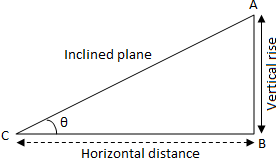
i.e., slope = \(\frac{vertical rise}{horizontal distance}\) = \(\frac{AB}{BC}\) = tan θ
Where θ is the angle which the plane makes with the horizontal
Slope of a
straight line:
The slope of a straight line is the tangent of its inclination and is denoted by letter ‘m’ i.e. if the inclination of a line is θ, its slope m = tan θ.
Note:
(i) The slope of a line is positive if it makes an acute angle in the anti-clockwise direction with x-axis.
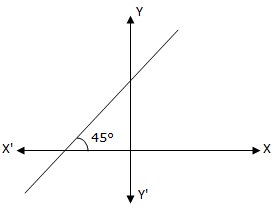 Inclination θ = 45° Therefore, slope = tan 45° = 1 |
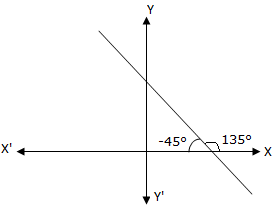 Inclination θ = 135° or -45° Therefore, slope = tan (-45°) = - tan 45° = -1 |
(ii) The slope of a line is negative, if it makes an obtuse angle in the anti-clockwise direction with the x-axis or an acute angle in the clockwise direction with the x-axis.
(iii) Since tan θ is not defined when θ = 90°, therefore, the slope of a vertical line is not defined. i.e., slope of y-axis is m = tan 90° = ∞ i.e., not defined.
(iv) Slope of x-axis is m = tan 0° = 0.
(v) Since the inclination of every line parallel to x-axis is 0°, so its slope (m) = tan 0° = 0. Therefore, the slope of every horizontal line is 0.
● Equation of a Straight Line
- Inclination of a Line
- Slope of a Line
- Intercepts Made by a Straight Line on Axes
- Slope of the Line Joining Two Points
- Equation of a Straight Line
- Point-slope Form of a Line
- Two-point Form of a Line
- Equally Inclined Lines
- Slope and Y-intercept of a Line
- Condition of Perpendicularity of Two Straight Lines
- Condition of parallelism
- Problems on Condition of Perpendicularity
- Worksheet on Slope and Intercepts
- Worksheet on Slope Intercept Form
- Worksheet on Two-point Form
- Worksheet on Point-slope Form
- Worksheet on Collinearity of 3 Points
- Worksheet on Equation of a Straight Line
Didn't find what you were looking for? Or want to know more information about Math Only Math. Use this Google Search to find what you need.

