Subscribe to our ▶️ YouTube channel 🔴 for the latest videos, updates, and tips.
Worksheet on Divisibility Rules – Printable Questions and Answers
- Home
- 5th Grade Math
- Worksheet on Divisibility Rules
This worksheet on divisibility rules is designed for students who are learning how to check whether a number is divisible by another number without performing long division. It is suitable for students in Grades 4, 5, and 6 and provides useful practice with divisibility tests.
The worksheet covers divisibility rules for 2, 3, 4, 5, 6, 7, 8, 9, 10, and 11. Students will practice identifying numbers that are divisible by a given number, finding missing digits, applying divisibility rules, and solving more challenging problems. The questions begin with basic practice and gradually move to more advanced divisibility problems.
This printable divisibility rules worksheet can be used for classroom practice, homework, revision, or independent learning. Learning divisibility rules helps students work with factors, multiples, prime numbers, HCF, and LCM more easily. An answer key is provided at the end so students can check their answers after completing the worksheet.
Divisibility Rules and Examples:
Divisibility by 2:
A number is divisible by 2, if the digit at ones place is an even number, that is the number ends in 0, 2, 4, 6 or 8. For example, 100, 222, 344, 1658 are divisible by 2.
Divisibility by 3:
A number is divisible by 3, if sum of all its digits is divisible by 3. Let us check if 27648 is divisible by 3. Sum of digits = 2 + 7 + 6 + 4 + 8 = 27; 27 ÷ 3 = 9. Hence 27648 is exactly divisible by 3.
Divisibility by 4:
A number is divisible by 4, if the number formed by its last 2 digits is divisible by 4. Let us check if 1124 is divisible by 4. Number formed by last 2 digits 24 is divisible by 4.
Divisibility by 5:
A number is divisible by 5, if it ends in 0 or 5. For example 100, 225, 605, 8000, 9925 are divisible by 5.
Divisibility by 6:
A number is divisible by 6 if it is divisible by both 2 and 3.
Rule:
- The last digit must be 0, 2, 4, 6, or 8.
- The sum of the digits must be divisible by 3.
Divisibility by 7:
Double the last digit and subtract it from the number formed by the remaining digits. If the result is 0 or divisible by 7, the original number is divisible by 7.
Divisibility by 8:
A number is divisible by 8 if its last three digits form a number that is divisible by 8.
Divisibility by 9:
A number is divisible by 9, if sum of its digits is divisible by 9. Let us check if 16911 is divisible by 9.
Sum of digits = 1 + 6 + 9 + 1 + 1 = 18. It is exactly divisible by 9.
Divisibility by 10:
All numbers ending in 0 are divisible by 10. For example 8000, 9010, 11020, 98670 are divisible by 10.
Divisibility by 11:
A number is divisible by 11 if the difference between the sums of alternate digits is 0 or a multiple of 11.
Divisibility Rules Covered
| Divisor | Divisibility Rule |
|---|---|
| 2 | Last digit is 0, 2, 4, 6 or 8. |
| 3 | Sum of digits is divisible by 3. |
| 4 | Last two digits are divisible by 4. |
| 5 | Last digit is 0 or 5. |
| 6 | The number is divisible by both 2 and 3. |
| 7 | Take the last digit, double it, and subtract that value from the rest of the number is 0 or a multiple of 7 |
| 8 | Last three digits are divisible by 8. |
| 9 | Sum of digits is divisible by 9. |
| 10 | Last digit is 0. |
| 11 | Difference between alternating digit sums is 0 or a multiple of 11. |
Printable Divisibility Rules Worksheets:
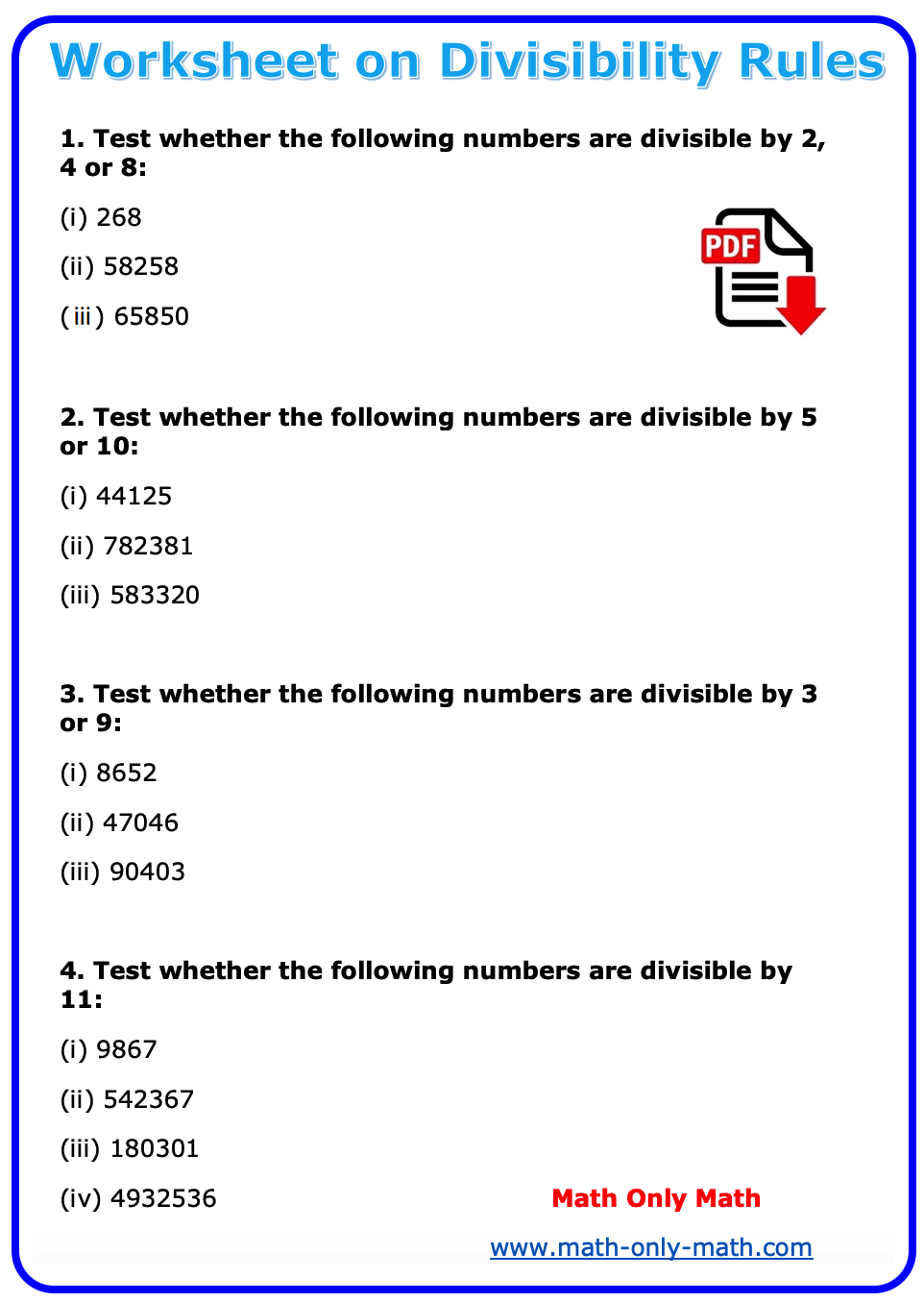

Basic Divisibility Rules (Questions 1–10):
1. Which of the following numbers are divisible by 2, 5 and 10?
(i) 149
(ii) 19400
(iii) 720345
(iv) 125370
(v) 3000000
2. Check whether the numbers are divisible by 4:
(i) 23408
(ii) 100246
(iii) 34972
(iv) 150126
(v) 58724
(vi) 19000
(vii) 43938
(viii) 846336
3. In each of the following numbers without doing actual division, determine whether the first number is divisible by the second number:
(i) 3409122; 6
(ii) 17218; 6
(iii) 11309634; 8
(iv) 515712; 8
(v) 3501804; 4
4. 6 is a factor of 12066 and 49320. Is 6 a factor of 49320 + 12066 and 49320 - 12066?
5. Is 9 a factor of the following?
(i) 394683
(ii) 1872546
(iii) 5172354
6. Fill in the smallest digit to make the number divisible by:
(i) by 5 : 7164__, 32197__
(ii) by 3 : 1__43, 47__05, __316
(iii) by 6 : __428, 9__52, 721__
(iv) by 4 : 2462__, 91__ __, 670__
(v) by 8 : 1232__, 59__16, 4642__
7. Using the divisibility rules check whether the number is divisible by the given numbers. Put P (tick) or û (cross).
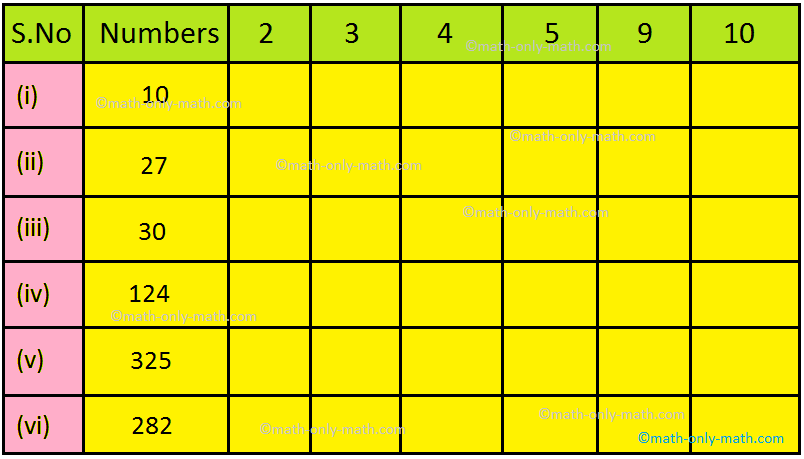
8. Check using divisibility rules and fill in the boxes using “Yes” or “No”.
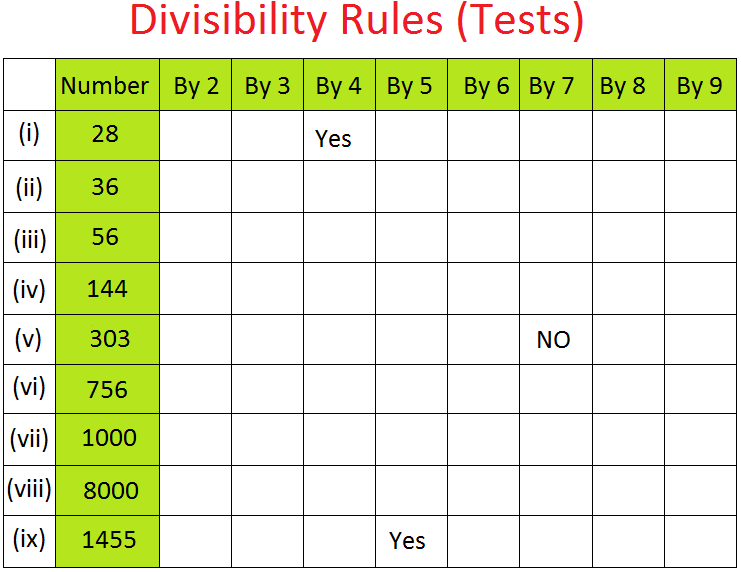
9. Which of the two nearest numbers to 19506 are divisible by 9?
10. Choose the right answer:
(i) The number with unit digit 0 or 5 is divisible by:
(a) 2
(b) 3
(c) 4
(d) 5
(ii) The number with unit digit 0, 2, 4, 6 or 8 is divisible by:
(a) 2
(b) 3
(c) 4
(d) 5
(iii) The number with unit digit 0 is divisible by:
(a) 5
(b) 10
(c) 15
(d) 2
(iv) 3681 is divisible by:
(a) 4
(b) 5
(c) 9
(d) 10
(v) 1170 is not divisible by:
(a) 10
(b) 9
(c) 5
(d) 4
(vi) Which of the following numbers is not divisible by 2?
(a) 1086
(b) 2869
(c) 3364
(d) 7000
(vii) Which of the following numbers is not divisible by 3?
(a) 1173
(b) 2391
(c) 3902
(d) 6048
(viii) Which of the following numbers is not divisible by 4?
(a) 1084
(b) 3516
(c) 3328
(d) 7001
(ix) Which of the following numbers is not divisible by 10?
(a) 2015
(b) 3000
(c) 4170
(d) 8990
(x) Which of the following numbers is divisible by 9?
(a) 1284
(b) 3510
(c) 4328
(d) 7301
Divisibility Practice (Questions 11–23):
11. Multiple Choice Questions (MCQ) on Divisibility Rules:
Tick (✔) the correct option.
(i) Which of the following numbers is divisible by 2?
(a) 2508; (b) 2711; (c) 3915; (d) 409
(ii) Which of the following numbers is divisible by 6?
(a) 5024; (b) 7125; (c) 3018; (d) 7123
(iii) Which of the following numbers is divisible by both 5 and 10?
(a) 1055; (b) 2305; (c) 675200; (d) 3124
(iv) Which of the following numbers is divisible by 6?
(a) 60466176; (b) 59624565; (c) 45879632; (d) Both (a) and (b)
(v) Which of the following numbers is divisible by 11?
(a) 77585896; (b) 55505555; (c) 11440411; (d) 19487171
12. Check the divisibility of the following numbers by 4:
(i) 19536
(ii) 9862
(iii) 28037
(iv) 675083
13. Check the divisibility of the following numbers by 6:
(i) 59730
(ii) 18620
(iii) 83652
(iv) 32508
14. Check the divisibility of the following numbers by 9:
(i) 1098
(ii) 871245
(ⅲ) 257069
(iv) 125083
15. Check the divisibility of the following numbers by 8:
(i) 9408
(ii) 871245
(iii) 57896
16. Check the divisibility of the following numbers by 11:
(i) 61809
(ii) 70169803
(iii) 3178965
17. State True or false.
(i) If two numbers are divisible by a number, then their sum, difference and product are also divisible by that number.
(ii) The largest 4-digit number divisible by 11 is 9999.
(iii) Numbers not divisible by 2 are called even numbers.
18. Match the Columns:
|
Column A |
Column B |
|
(i) 2023 (ii) 24804 (iii) 12892 (iv) 6016 |
(a) divisible by 3 (b) divisible by 11 (c) divisible by 8 (d) divisible by 7 |
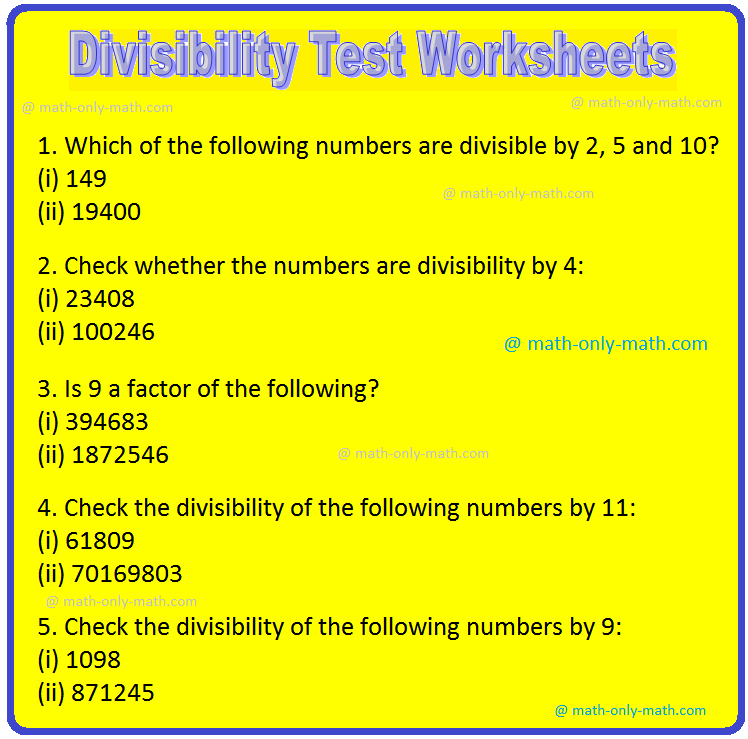
19. Test whether the following numbers are divisible by 2, 4 or 8:
(i) 268
(ii) 58258
(ⅲ) 65850
20. Test whether the following numbers are divisible by 5 or 10:
(i) 44125
(ii) 782381
(iii) 583320
21. Test whether the following numbers are divisible by 3 or 9:
(i) 8652
(ii) 47046
(iii) 90403
22. Test whether the following numbers are divisible by 11:
(i) 9867
(ii) 542367
(iii) 180301
(iv) 4932536
23. Test whether the following numbers are divisible by 6:
(i) 8459
(ii) 92376
(iii) 72846
(iv) 93672
Fill in the Missing Digit (Questions 24–26):
24. Fill in the blanks with the smallest digit to make the number divisible by 3:
(i) 5 _ 860
(ii) 47 _ 93
(iii) 944 _ 4
(iv) 5 _ 7705
25. Fill in the blanks with the smallest digit to make the number divisible by 9:
(i) _ 9569
(ii) 74 _ 08
(iii) 276 _ 47
(iv) 2923 _ 1
26. Fill in the blanks with the smallest digit to make the number divisible by 11:
(i) 315 _ 5
(ii) 6338 _ 9
(iii) 33 _ 8231
(iv) 55 _ 5755
Challenge Questions (Questions 27–33):
27. Find the largest number that you need to test as a divisor to determine whether each of the following is a prime number:
(i) 101
(ii) 111
(iii) 397
(iv) 401
(v) 487
(vi) 227
28. If a number is divisible by 2 and 7, will it be divisible by 14? Give an example.
29. If a number is divisible by 4 and 6, is it necessary that it will be divisible by 24? If not, write one such number.
30. Is 5720910 divisible by 7?
31. A number is divisible by both 6 and 11. By which other number will that number be always divisible?
32. A number is divisible by 45. By what other numbers will that number be divisible?
33. State True or False.
(i) If a number is divisible by 9, it must be divisible by 3.
(ii) If a number is divisible by 3 and 6, it is divisible by 18.
(iii) All numbers which are divisible by 2 must also be divisible by 4.
(iv) If a number exactly divides the sum of two numbers, it must exactly divides the two numbers separately.
Answers for the worksheet on divisibility rules are given below.
Answer Key
1. (ii) 19400
(iv) 125370
(v) 3000000
2. (i) 23408
(iii) 34972
(v) 58724
(vi) 19000
(viii) 846336
3. (i) Yes
(ii) No
(iii) No
(iv) Yes
(v) Yes
4. Yes
5. (iii) 5172354
6. (i) 0, 0
(ii) 1, 2, 2
(iii) 1, 2, 2
(iv) 0, 00, 0
(v) 0, 0, 4
7. (i) P, û, û, P, û, P
(ii) û, P, û, û, P, û
(iii) P, P, û, P, û, P
(iv) P, û, P, û, û, û
(v) û, û, û, P, û, û
(vi) P, P, û, û, û, û
8. (i) Yes, No, Yes, No, No, Yes, No, No
(ii) Yes, Yes, Yes, No, Yes, No, No, Yes
(iii) Yes, No, Yes, No, No, Yes, Yes, No
(iv) Yes, Yes, Yes, No, Yes, No, Yes, Yes
(v) No, Yes, No, No, No, No, No, No
(vi) Yes, Yes, Yes, No, Yes, Yes, No, Yes
(vii) Yes, No, Yes, Yes, No, No, Yes, No
(viii) Yes, No, Yes, Yes, No, No, Yes, No
(ix) No, Yes, No, Yes, No, No, No, No
9. 19503, 19512
10. (i) (d) 5
(ii) (a) 2
(iii) (b) 10
(iv) (c) 9
(d) 10
(v) (d) 4
(vi) (b) 2869
(vii) (c) 3902
(viii) (d) 7001
(ix) (a) 2015
(x) (b) 3510
11. (i) (a) 2508
(ii) (c) 3018
(iii) (c) 675200
(iv) (a) 60466176
(v) (d) 19487171
12. (i) 19536 is divisible by 4
(ii) 9862 is not divisible by 4
(iii) 28037 is not divisible by 4
(iv) 675083 is not divisible by 4
13. (i) 59730 is divisible by 6
(ii) 18620 is not divisible by 6
(iii) 83652 is divisible by 6
(iv) 32508 is divisible by 6
14. (i) 1098 is divisible by 9
(ii) 871245 is divisible by 9
(ⅲ) 257069 is not divisible by 9
(iv) 125083 is not divisible by 9
15. (i) 9408 is divisible by 8
(ii) 871245 is not divisible by 8
(iii) 57896 is divisible by 8
16. (i) 61809 is divisible by 11
(ii) 70169803 is divisible by 11
(iii) 3178965 is not divisible by 11
17. (i) True
(ii) True
(iii) False
18. (i) → (d)
(ii) → (a)
(iii) → (b)
(iv) → (c)
19. (i) Divisible by 2 and 4.
(ii) Divisible by 2 and 4.
(ⅲ) Divisible by 2 only.
20. (i) Divisible by 5 only.
(ii) Neither divisible by 5 nor by 10.
(iii) Divisible by both 5 and 10.
21. (i) Divisible by 3 only.
(ii) Divisible by 3 only.
(iii) Neither divisible by 3 nor by 9.
22. (i) Yes
(ii) No
(iii) Yes
(iv) No
23. (i) No
(ii) Yes
(iii) Yes
(iv) Yes
24. (i) 2
(ii) 1
(iii) 0
(iv) 0
25. (i) 7
(ii) 8
(iii) 1
(iv) 1
26. (i) 1
(ii) 0
(iii) 8
(iv) 9
27. (i) 11, Yes
(ii) No
(iii) 19, Yes
(iv) 23, Yes
(v) 23, Yes
(vi) 17, Yes
28. Yes, 28
29. No, 36
30. No
31. 66
32. 1, 3, 5, 9, 15 and 45
33. State True or False.
(i) True
(ii) False
(iii) False
(iv) False
Divisibility Rules Practice Quiz:
Divisibility Rules Challenge Quiz
Test your skills with divisibility rules from 2 to 11. Choose an answer, learn from the feedback, and try to earn a perfect score!
10 random questions • Instant feedback • Final score
Quiz Complete!
Question Review
| # | Question | Your Answer | Correct Answer |
|---|
Frequently Asked Questions (FAQs) on Divisibility Rules:
1. What is a divisibility rule?
1. What is a divisibility rule?
Answer:
A divisibility rule is a simple method used to check whether a number can be divided exactly by another number without leaving a remainder.
2. What are the divisibility rules covered in this worksheet?
2. What are the divisibility rules covered in this worksheet?
Answer:
This worksheet covers divisibility rules for 2, 3, 4, 5, 6, 7, 8, 9, 10, and 11.
3. Is this divisibility rules worksheet suitable for Grade 5 students?
3. Is this divisibility rules worksheet suitable for Grade 5 students?
Answer:
Yes. This worksheet is suitable for students in Grades 4, 5, and 6 who are learning and practising divisibility rules.
7. Why are divisibility rules useful?
7. Why are divisibility rules useful?
Answer:
Divisibility rules help students quickly determine whether a number is divisible by another number without performing long division.
5. How do you check if a number is divisible by 7?
5. How do you check if a number is divisible by 7?
Answer:
Double the last digit and subtract the result from the number formed by the remaining digits. If the result is 0 or divisible by 7, the original number is divisible by 7.
6. Can this divisibility rules worksheet be used for practice?
6. Can this divisibility rules worksheet be used for practice?
Answer:
Yes. Students can use it for classroom practice, homework, revision, or independent learning. An answer key is also provided to check the answers.
About Author

Written by Priyanka Ghosh
Mathematics Educator | Founder of Math Only Math
Priyanka Ghosh has been teaching elementary and middle-school mathematics for over 12 years and specializes in creating simple, child-friendly math lessons and worksheets.
Related Resources:
Problems on Divisibility Rules
Worksheet on Divisibility Rules
From Worksheet on Divisibility Rules to HOME PAGE
Didn't find what you were looking for? Or want to know more information about Math Only Math. Use this Google Search to find what you need.



)
