Subscribe to our ▶️ YouTube channel 🔴 for the latest videos, updates, and tips.
Pythagorean Theorem Word Problems with Answers
- Math Only Math
- 8th Grade Math
- Word Problems on Pythagorean Theorem
The Pythagorean Theorem helps us solve real-life problems involving right triangles. It states that the square of the hypotenuse is equal to the sum of the squares of the other two sides. This theorem is especially useful when we need to find an unknown distance, height, or side length.
In this lesson, we will learn how to solve different types of Pythagorean Theorem word problems step by step using simple explanations, diagrams, and worked examples. We will explore practical situations such as finding the distance between two points, calculating the height of a ladder against a wall, finding the diagonal of a rectangle, and determining the distance between two buildings.
You will also practice identifying the hypotenuse and the two legs of a right triangle, choosing the correct equation, and calculating the missing side.
These examples and practice problems are designed to help Grade 8 students understand the Pythagorean Theorem and apply it confidently to real-world mathematical situations.
In this lesson, you will learn how to:
- Find the hypotenuse when the lengths of the other two sides are given.
- Find a missing leg when the hypotenuse and one leg are known.
- Solve real-life distance and height problems using the Pythagorean Theorem.
- Apply the theorem to rectangles, ladders, buildings, and other everyday situations.
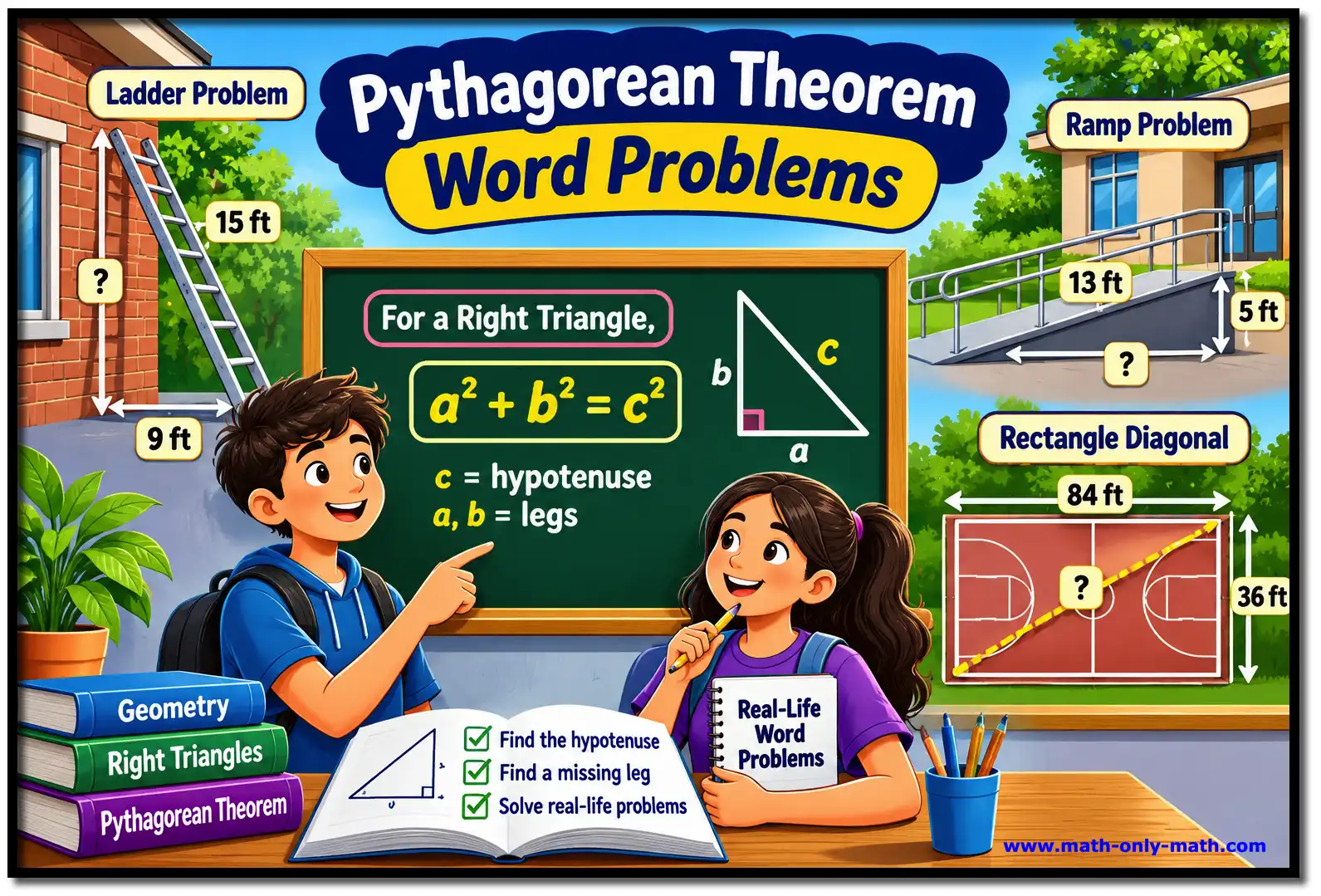
Learn how to solve different types of word problems on Pythagorean Theorem.
Pythagoras Theorem can be used to solve the problems step-by-step when we know the length of two sides of a right angled triangle and we need to get the length of the third side.
Three cases of word problems on Pythagorean Theorem:
Case 1: To find the hypotenuse where perpendicular and base are given.
Case 2: To find the base where perpendicular and hypotenuse are given.
Case 3: To find the perpendicular where base and hypotenuse are given.
How to Solve Pythagorean Theorem Word Problems
Solving Pythagorean Theorem word problems becomes easier when you follow a few simple steps. First, identify the right triangle in the problem. Then determine which side is unknown and use the Pythagorean Theorem to find its length.
The Pythagorean Theorem Formula
a and b are the two legs of a right triangle, and c is the hypotenuse (the longest side, opposite the right angle).
The hypotenuse (c) is always opposite the right angle.
Follow These 3 Steps to Solve Word Problems
Read the Problem and Identify the Triangle
Read the word problem carefully. Look for two directions, distances, heights, or lengths that form a right angle. Draw a simple diagram and label the known sides.
Remember: The hypotenuse is the longest side of a right triangle and is always opposite the 90° angle.
Choose the Correct Formula
Decide whether you need to find the hypotenuse or one of the two legs.
c = √(a² + b²)
a = √(c² − b²)
Use the appropriate equation based on the information given in the problem.
Solve and Write the Final Answer
Substitute the known side lengths into the formula. Simplify the equation and calculate the missing side. Finally, include the correct unit, such as inches, feet, centimeters, or meters.
Let's Understand with an Example
A ladder is placed against a wall. The bottom of the ladder is 6 feet away from the wall, and the top reaches a height of 8 feet. Find the length of the ladder.
Step 1: Identify the given information.
Step 2: Apply the Pythagorean Theorem.
Step 3: Find the square root.
Solved Pythagorean Theorem Word Problems
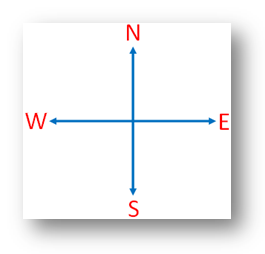
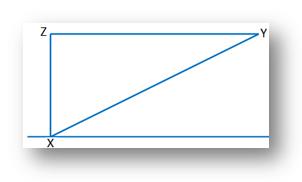
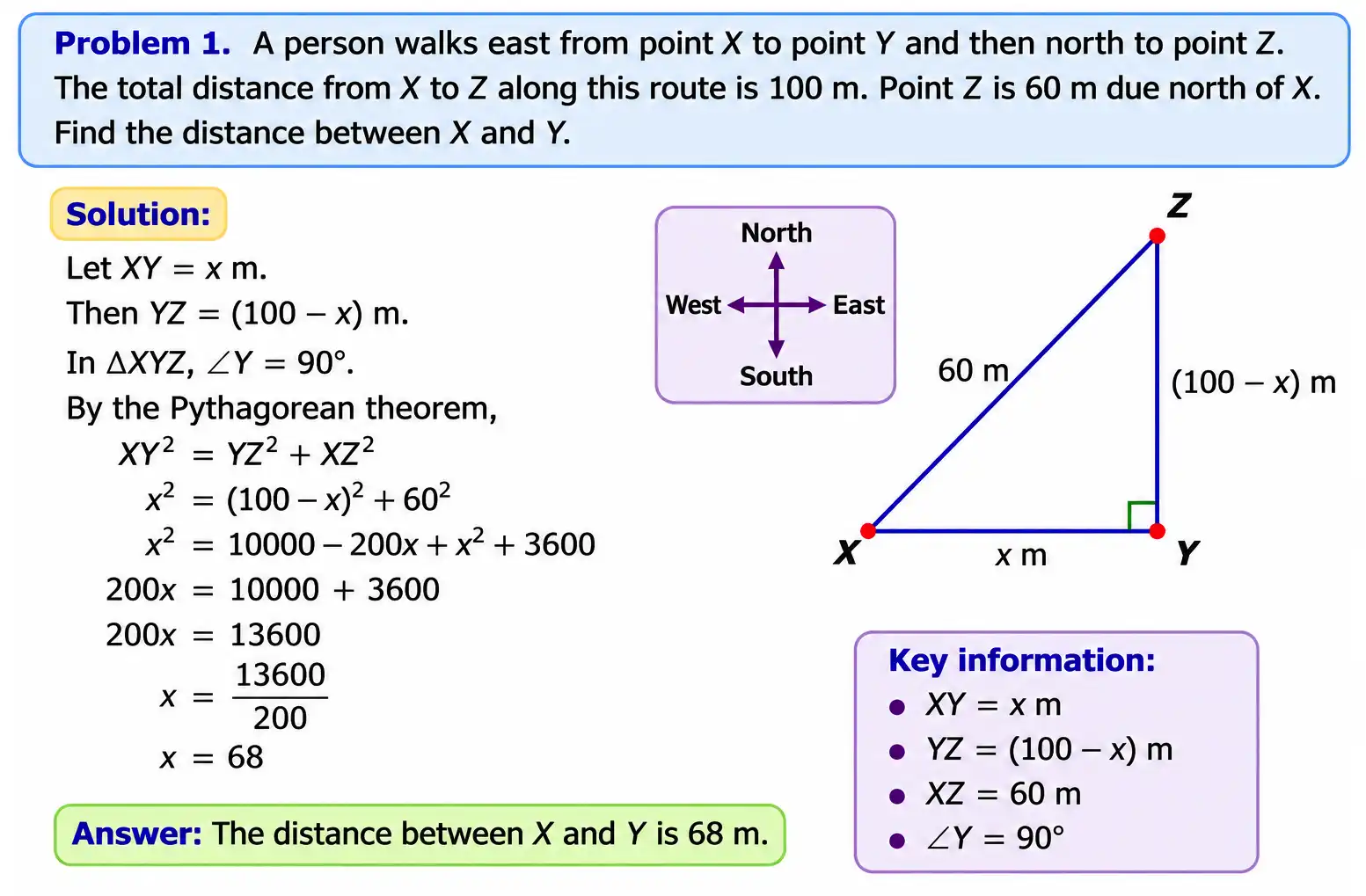
1. A person has to walk 100 m to go from position X in the north of east
direction to the position B and then to the west of Y to reach finally at
position Z. The position Z is situated at the north of X and at a distance of
60 m from X. Find the distance between X and Y.
|
Solution: Let XY = x m Therefore, YZ = (100 – x) m
In ∆ XYZ, ∠Z = 90° Therefore, by Pythagoras theorem XY2 = YZ2 + XZ2⇒ x2 = (100 – x)2 + 602 ⇒ |
 |
⇒ 200x = 10000 + 3600
⇒ 200x = 13600
⇒ x = 13600/200
⇒ x = 68
Therefore, distance between X and Y = 68 meters.
2. The square of the hypotenuse of an isosceles right triangle is 128 cm². Find the length of each of its two equal legs.
Solution:
Let the two equal side of right angled isosceles triangle, right angled at Q be k cm.Given: h2 = 128
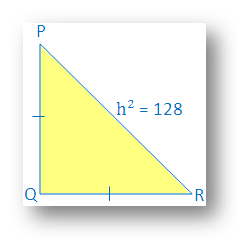
So, we get
PR2 = PQ2 + QR2
h2 = k2 + k2
⇒ 128 = 2k2
⇒ 128/2 = k2
⇒ 64 = k2
⇒ √64 = k
⇒ 8 = k
Therefore, length of each side is 8 cm.
Using the formula solve more word problems on Pythagorean Theorem.
3. Find the perimeter of a rectangle whose length is 150 m and the diagonal is 170 m.
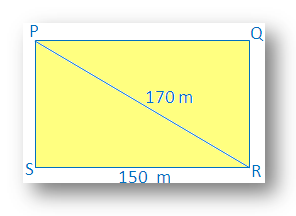
Solution:
In a rectangle, each angle measures 90°.
Therefore PSR is right angled at S
Using Pythagoras theorem, we get
⇒ PS2 + SR2 = PR2⇒ PS2 + 1502 = 1702
⇒ PS2 = 1702 – 1502
⇒ PS2= (170 + 150) (170 – 150), [using the formula of a2 - b2 = (a + b) (a - b)]
⇒ PS2= 320 × 20
⇒ PS2 = 6400
⇒ PS = √6400
⇒ PS = 80
Therefore perimeter of the rectangle PQRS = 2 (length + width)
= 2 (150 + 80) m
= 2 (230) m
= 460 m
4. A ladder 13 m long is placed on the ground in such a way that it touches the top of a vertical wall 12 m high. Find the distance of the foot of the ladder from the bottom of the wall.
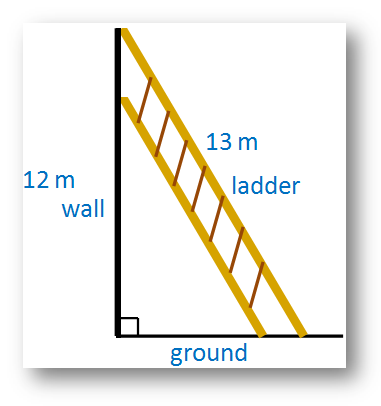
Solution:
Let the required distance be x meters. Here, the ladder, the wall and the ground from a right-angled triangle. The ladder is the hypotenuse of that triangle.
According to Pythagorean Theorem,
x2 + 122 = 132⇒ x2 = 132 – 122
⇒ x2 = (13 + 12) (13 – 12)
⇒ x2 = (25) (1)
⇒ x2 = 25
⇒ x = √25
⇒ x = 5
Therefore, distance of the foot of the ladder from the bottom of the wall = 5 meters.
5. The height of two building is 34 m and 29 m respectively. If the distance between the two building is 12 m, find the distance between their tops.
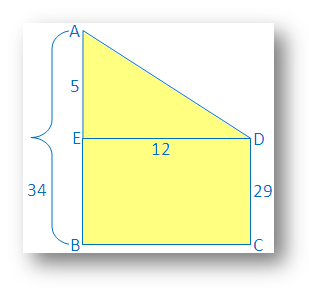
Solution:
The vertical buildings AB and CD are 34 m and 29 m respectively.
Draw DE ┴ AB
Then AE = AB – EB but EB = BC
Therefore
AE = 34 m - 29 m = 5 m
Now, AED is right angled triangle and right angled at E.
Therefor,
AD2 = AE2 + ED2⇒ AD2 = 52 + 122
⇒ AD2 = 25 + 144
⇒ AD2 = 169
⇒ AD = √169
⇒ AD = 13
Therefore the distance between their tops = 13 m.
The examples will help us to solve various types of word problems on Pythagorean Theorem.
Real-Life Pythagorean Theorem Word Problems
The Pythagorean Theorem is useful in many everyday situations. We can use it to calculate the length of a ramp, find the shortest distance across a baseball field, or determine how far a kite is from the person flying it.
Let's understand how to apply the Pythagorean Theorem to different real-life situations using the following word problems and step-by-step solutions.
Wheelchair Ramp at a Building
A wheelchair ramp is being built to reach the entrance of a building. The entrance is 2.5 feet above the ground, and the horizontal distance from the ramp's starting point to the building is 6 feet. Find the length of the ramp.
The ramp, ground, and building form a right triangle.
- Vertical height = 2.5 feet
- Horizontal distance = 6 feet
- Length of ramp = Unknown (hypotenuse)
Step-by-Step Solution
Distance Across a Baseball Diamond
A baseball diamond is shaped like a square. The distance between two consecutive bases is 90 feet. A player wants to throw the ball directly from home plate to second base. Find the shortest distance the ball must travel.
The diagonal from home plate to second base divides the square into two right triangles.
- Length of one side = 90 feet
- Width of the square = 90 feet
- Diagonal distance = Unknown
Step-by-Step Solution
Flying a Kite
A child is flying a kite with a 50-foot string. The kite is 40 feet above the ground. Assuming the string is straight and taut, how far is the child from the point directly below the kite?
The kite string is the hypotenuse, and the height is one of the two legs.
- Length of kite string = 50 feet
- Height of kite = 40 feet
- Horizontal distance = Unknown
Step-by-Step Solution
What We Learned
The Pythagorean Theorem can help us solve many practical problems involving right triangles.
- Use addition when finding the hypotenuse.
- Use subtraction when finding a missing leg.
- Always identify the right angle before applying the formula.
- Include the correct unit in the final answer.
Pythagorean Theorem Practice Problems with Answers
Now that you have learned how to apply the Pythagorean Theorem, try these practice problems. Work through each question and calculate the missing side of the right triangle. Reveal the step-by-step solution to check your answer and understand the method.
Instructions: Try solving each problem on your own before clicking the "Show Answer" button.
Easy LevelFind the Missing Hypotenuse
A right triangle has two legs measuring 9 inches and 12 inches. Find the length of its hypotenuse.
Answer: 15 inches.
The hypotenuse of a right triangle is 13 cm, and one leg is 5 cm. Find the length of the other leg.
Answer: 12 cm.
A square has a side length of 8 inches. Find the length of its diagonal.
Answer: Approximately 11.31 inches.
Two points on a coordinate plane are A(2, 3) and B(8, 11). Find the distance between them.
Answer: 10 units.
Apply the Theorem to Real-Life Situations
A window cleaner places a 17-foot ladder against a building. The bottom of the ladder is 8 feet away from the wall. How high up the wall does the ladder reach?
Answer: 15 feet.
A rectangular garden is 24 feet long and 10 feet wide. A gardener wants to walk diagonally from one corner to the opposite corner. How far will the gardener walk?
Answer: 26 feet.
A drone flies 12 feet horizontally and then rises 16 feet vertically from its starting point. What is the straight-line distance between its starting point and ending point?
Answer: 20 feet.
A sailboat travels 15 miles east and then 20 miles north. How far is the boat from its starting point in a straight line?
Answer: 25 miles.
Think Carefully and Solve
A television screen is 48 inches wide and has a diagonal measurement of 60 inches. Find the height of the screen.
Answer: 36 inches.
A rectangular swimming pool has a diagonal of 65 feet and a width of 25 feet. Find its length.
Answer: 60 feet.
A student walks from point P(−3, 2) to point Q(5, 17) on a coordinate plane. Find the straight-line distance between the two points.
Answer: Approximately 18.60 units.
A rectangular field has a perimeter of 140 yards. Its diagonal is 50 yards. Find the length and width of the field.
Answer: Length = 40 yards and width = 30 yards.
Common Mistakes to Avoid When Solving Pythagorean Theorem Word Problems
The Pythagorean Theorem is easy to apply once you understand how the three sides of a right triangle are related. However, students sometimes make mistakes when identifying the hypotenuse, choosing the correct equation, or calculating the missing side.
Let's look at some common mistakes and learn how to avoid them when solving Pythagorean Theorem word problems.
Confusing the Hypotenuse with a Leg
The hypotenuse is the longest side of a right triangle. It is always opposite the 90° angle. It is not necessarily the horizontal or vertical side.
Remember: The hypotenuse is opposite the right angle.
Adding Instead of Subtracting When Finding a Missing Leg
When the hypotenuse and one leg are known, subtract the square of the known leg from the square of the hypotenuse.
Example: The hypotenuse is 13 cm and one leg is 5 cm. Find the other leg.
Answer: The missing leg is 12 cm.
Forgetting to Take the Square Root
After finding the square of the missing side, you must take the square root to find the actual side length.
Example: A right triangle has legs of 9 feet and 12 feet. Find the hypotenuse.
Answer: The hypotenuse is 15 feet.
Using the Theorem for a Triangle That Is Not Right-Angled
The Pythagorean Theorem applies only to right triangles. It cannot be used directly for an acute or obtuse triangle.
Ignoring Units in the Final Answer
When solving a word problem, always include the correct unit with your final answer.
Example: A ladder is 10 feet long and its bottom is 6 feet from a wall. Find the height reached by the ladder.
Rounding Too Early
Some problems do not produce a whole-number answer. Rounding intermediate calculations too early can lead to an inaccurate final result.
Example: A right triangle has legs of 5 cm and 7 cm. Find the hypotenuse.
Keep the exact square-root form until the final step. Round only when the question asks you to do so.
Quick Checklist: Before You Submit Your Answer
- Did I identify the right angle?
- Did I correctly identify the hypotenuse?
- Did I choose the correct equation?
- Did I substitute the side lengths correctly?
- Did I take the square root?
- Did I include the correct unit?
- Did I round only at the final step?
Pythagorean Theorem Interactive Quiz
Test your knowledge of the Pythagorean Theorem with these interactive practice questions. Start with the easy level, move on to medium-level word problems, and challenge yourself with advanced questions. After completing the quiz, check the answer review table to understand your mistakes and improve your problem-solving skills.
Choose your difficulty level:
Each quiz contains 10 randomly selected questions. There is no time limit, so take your time and show your working on paper.
Select one answer to continue.
Quiz Results
Your final score
Good effort!
Answer Review Table
Review each question, compare your answer with the correct answer, and read the explanation to understand the method.
| Q. No. | Question | Your Answer | Correct Answer | Result | Explanation |
|---|
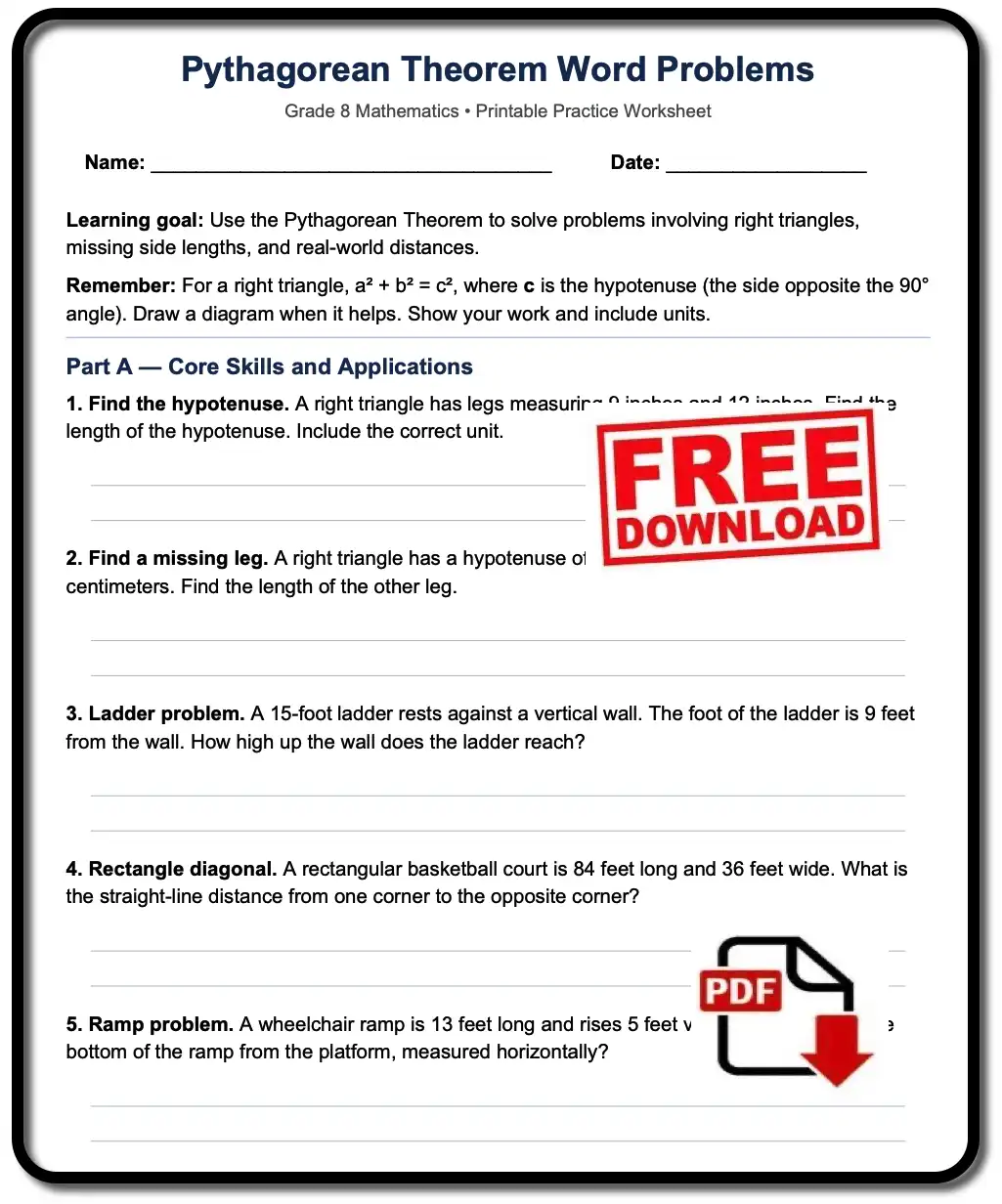
Free Printable Pythagorean Theorem Worksheets
Pythagorean Theorem Word Problems Worksheet |
Frequently Asked Questions About Pythagorean Theorem Word Problems
1. What is the Pythagorean Theorem?
1. What is the Pythagorean Theorem?
Answer:
The Pythagorean Theorem is a mathematical rule used to find a missing side length of a right triangle. It states that the sum of the squares of the two legs equals the square of the hypotenuse.
Formula: a2 + b2 = c2, where c is the hypotenuse.
2. How do you solve Pythagorean Theorem word problems?
2. How do you solve Pythagorean Theorem word problems?
Answer:
Follow these steps:
- Read the problem and identify the right triangle.
- Identify the two legs and the hypotenuse.
- Write the Pythagorean Theorem formula.
- Substitute the known side lengths.
- Solve for the missing side and include the correct unit.
3. How do you find the hypotenuse of a right triangle?
3. How do you find the hypotenuse of a right triangle?
Answer:
Square the lengths of both legs, add the squares, and take the square root of the sum.
Example: If the legs are 3 inches and 4 inches, then:
c = √(32 + 42) = √25 = 5 inches.
4. How do you find a missing leg using the Pythagorean Theorem?
4. How do you find a missing leg using the Pythagorean Theorem?
Answer:
When the hypotenuse and one leg are known, subtract the square of the known leg from the square of the hypotenuse. Then take the square root.
Formula: a = √(c2 − b2).
Example: If the hypotenuse is 13 cm and one leg is 5 cm, the missing leg is √(169 − 25) = 12 cm.
5. How do you know which side is the hypotenuse?
5. How do you know which side is the hypotenuse?
Answer:
The hypotenuse is the longest side of a right triangle. It is always opposite the 90-degree angle. The other two sides are called the legs.
6. Can the Pythagorean Theorem be used for any triangle?
6. Can the Pythagorean Theorem be used for any triangle?
Answer:
No. The Pythagorean Theorem applies only to right triangles, which have one angle measuring exactly 90 degrees. It cannot be applied directly to an acute or obtuse triangle.
7. What are some real-life applications of the Pythagorean Theorem?
7. What are some real-life applications of the Pythagorean Theorem?
Answer:
The Pythagorean Theorem is useful in many real-life situations, such as finding the length of a ladder leaning against a wall, calculating the diagonal of a rectangular room, measuring the shortest distance between two locations, and determining the horizontal length of a ramp.
8. What is a Pythagorean triple?
8. What is a Pythagorean triple?
Answer:
A Pythagorean triple is a set of three positive whole numbers that satisfy the Pythagorean Theorem. Common examples include 3, 4, 5; 5, 12, 13; and 8, 15, 17.
9. Do you always need to use the square root when solving these problems?
9. Do you always need to use the square root when solving these problems?
Answer:
When finding a missing side length from its squared value, you take the square root to obtain the actual length. For example, if x2 = 144, then x = √144 = 12.
10. What grade do students learn the Pythagorean Theorem?
10. What grade do students learn the Pythagorean Theorem?
Answer:
In the United States, students commonly learn the Pythagorean Theorem in Grade 8 mathematics. It is included in the Common Core State Standards under 8.G.B.7, which focuses on applying the theorem to find unknown side lengths in right triangles.
Related Math Lessons
About Author

Written by Priyanka Ghosh
Mathematics Educator | Founder of Math Only Math
Priyanka Ghosh has been teaching elementary and middle-school mathematics for over 12 years and specializes in creating simple, child-friendly math lessons and worksheets.
From Word problems on Pythagorean Theorem to HOME PAGE
Didn't find what you were looking for? Or want to know more information about Math Only Math. Use this Google Search to find what you need.



