Subscribe to our ▶️ YouTube channel 🔴 for the latest videos, updates, and tips.
4 Times Table Multiplication Chart
- Math Only Math
- Multiplication Table
- 4 Times Table Multiplication Chart
Learn the 4 times table with this easy-to-read multiplication chart, fun patterns, interactive quizzes, and free printable worksheets. The table of 4 helps students understand multiplication as equal groups and repeated addition.
Practice multiplication facts from 4 × 1 = 4 to 4 × 12 = 48. Use skip counting by 4s, learn how doubling the 2 times table helps, and solve real-life multiplication word problems. This page is designed to help elementary students build multiplication fluency through visual learning and hands-on practice.
In 4 times table multiplication chart we will learn about the tables and then we will practice the exercise.
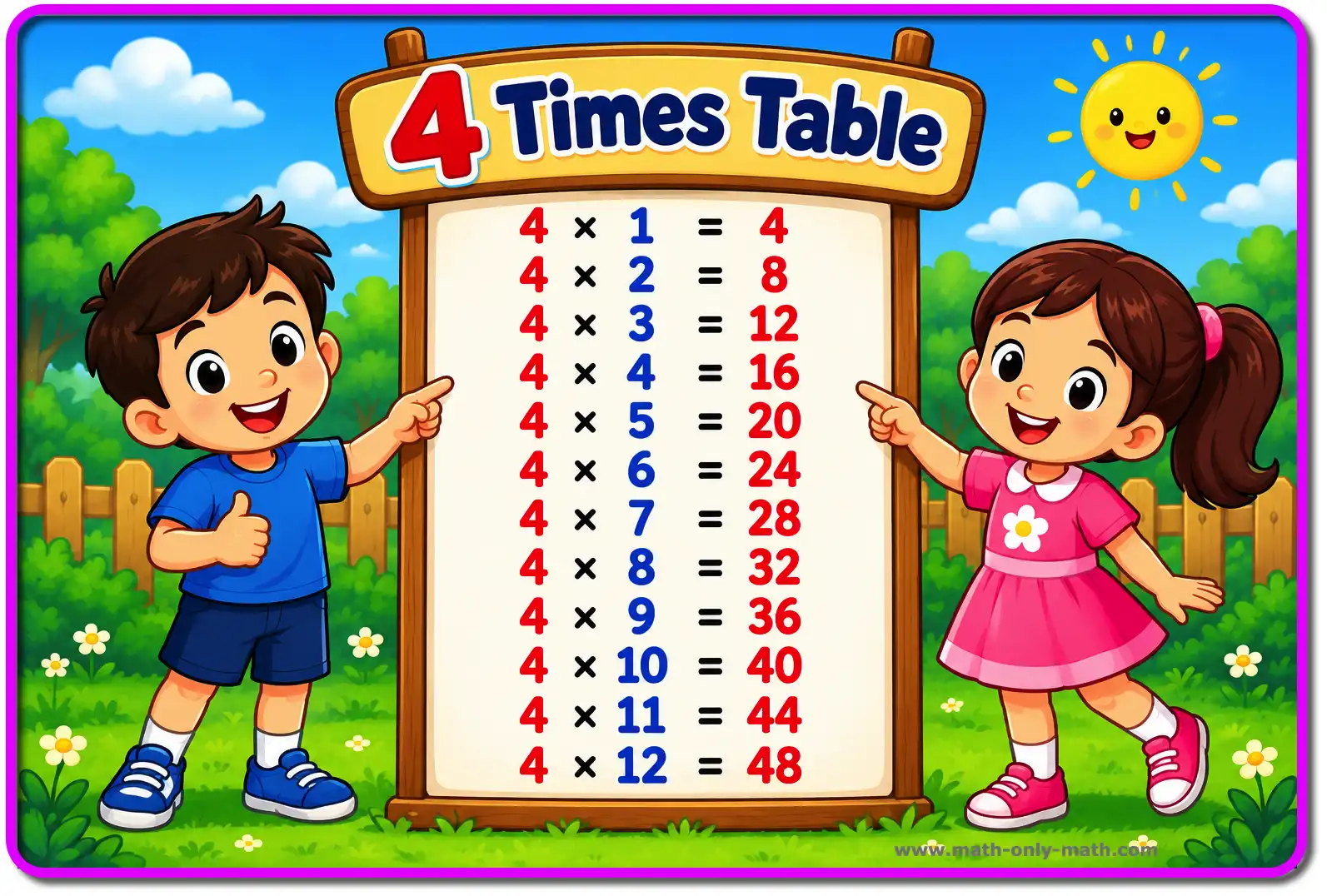
4 Times Table Chart
Multiplication facts from 1 to 12
| Multiplication | Answer |
|---|---|
| 1 × 4 | 4 |
| 2 × 4 | 8 |
| 3 × 4 | 12 |
| 4 × 4 | 16 |
| 5 × 4 | 20 |
| 6 × 4 | 24 |
| 7 × 4 | 28 |
| 8 × 4 | 32 |
| 9 × 4 | 36 |
| 10 × 4 | 40 |
| 11 × 4 | 44 |
| 12 × 4 | 48 |
Learning tip: Add 4 to the previous answer to find the next answer.
What Is the 4 Times Table?
The 4 times table is a list of multiplication facts that show what happens when we multiply a number by 4. It helps students learn to count groups of four quickly and solve multiplication problems.
Simple definition: Multiplying a number by 4 means finding the total number of objects in 4 equal groups of that number.
Examples of Multiplication by 4
Learn the 4 Times Table Through Repeated Addition
Multiplication by 4 can also be understood as adding 4 again and again. For example, 3 × 4 means adding three groups of 4.
Similarly, 5 × 4 means adding five 4s:
Visual Example: 4 Groups of 4
Imagine putting 4 pencils into each of 4 boxes. Each box has the same number of pencils, so you can multiply to find the total.
● ●
● ●
● ●
● ●
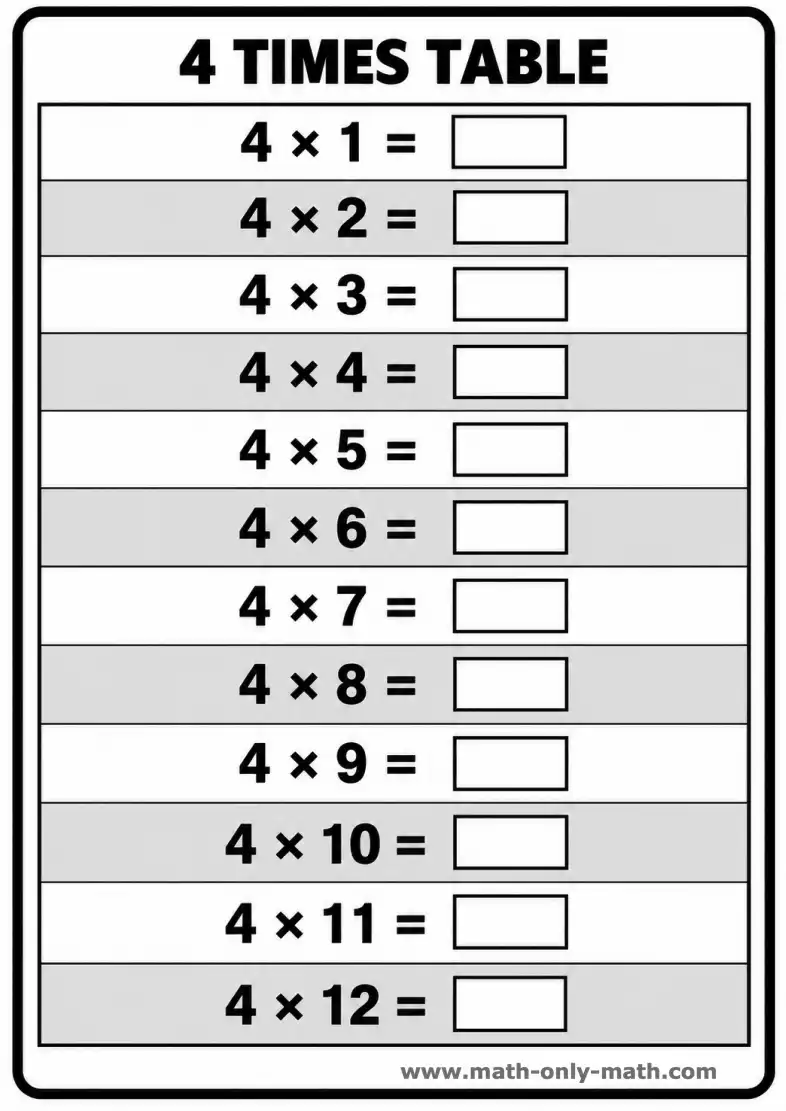
Print out the multiplication table of 4 and hang it on your wall which will help you to learn 4 times tables.
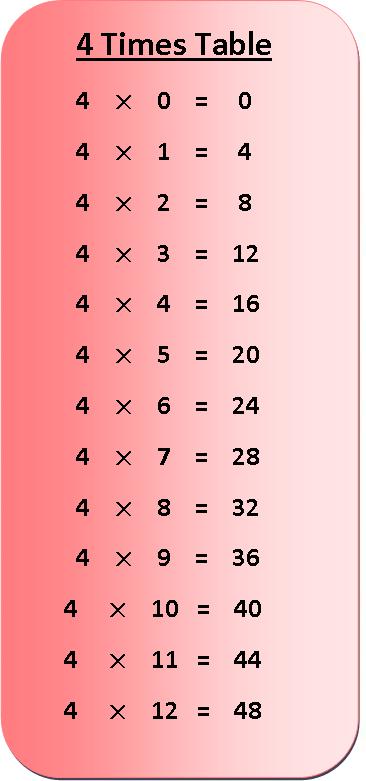
Download the 4 times table multiplication chart and then print it out.
How to Read and Write the 4 Times Table
Learning to read and write multiplication facts helps students remember the 4 times table. Each fact tells us how many objects there are when we have equal groups of four.
1. How to Read the 4 Times Table
Read the multiplication sign (×) as "times" and the equals sign (=) as "equals".
4 × 1 = 4
Read it as: Four times one equals four.
4 × 2 = 8
Read it as: Four times two equals eight.
4 × 3 = 12
Read it as: Four times three equals twelve.
4 × 4 = 16
Read it as: Four times four equals sixteen.
2. How to Write the 4 Times Table
Start with the number 4. Add another 4 to get the next answer. Continue adding 4 to complete the table.
For example, after 4 × 3 = 12, add 4 to 12 to get 16. Therefore, 4 × 4 = 16.
3. Read and Write the Complete 4 Times Table
| Multiplication Fact | Read Aloud | Answer |
|---|---|---|
| 4 × 1 = 4 | Four times one equals four | 4 |
| 4 × 2 = 8 | Four times two equals eight | 8 |
| 4 × 3 = 12 | Four times three equals twelve | 12 |
| 4 × 4 = 16 | Four times four equals sixteen | 16 |
| 4 × 5 = 20 | Four times five equals twenty | 20 |
| 4 × 6 = 24 | Four times six equals twenty-four | 24 |
| 4 × 7 = 28 | Four times seven equals twenty-eight | 28 |
| 4 × 8 = 32 | Four times eight equals thirty-two | 32 |
| 4 × 9 = 36 | Four times nine equals thirty-six | 36 |
| 4 × 10 = 40 | Four times ten equals forty | 40 |
| 4 × 11 = 44 | Four times eleven equals forty-four | 44 |
| 4 × 12 = 48 | Four times twelve equals forty-eight | 48 |
Patterns in the 4 Times Table
The 4 times table has simple number patterns that make multiplication easier to learn. When students notice these patterns, they can remember multiplication facts instead of memorizing every answer separately.
1. The Answers Increase by 4
Each time you move to the next multiplication fact in the 4 times table, add 4 to the previous answer.
Example: After 4 × 5 = 20, add 4. The next answer is 24, so 4 × 6 = 24.
2. Every Answer Is an Even Number
All products in the 4 times table are even numbers. An even number can be divided into two equal whole-number groups.
Notice that none of these answers is odd. The pattern continues for every whole-number multiple of 4.
3. The Last Digit Follows a Pattern
Look at the last digit of the answers in the 4 times table. The digits repeat in the same order.
For example, 4 × 1 = 4, 4 × 2 = 8, 4 × 3 = 12, 4 × 4 = 16, and 4 × 5 = 20.
4. The 4 Times Table Is Double the 2 Times Table
Since 4 is twice 2, you can find a fact in the 4 times table by doubling the corresponding answer in the 2 times table.
5. The 4 Times Table Can Be Written as Repeated Addition
Multiplication by 4 can also be understood by adding 4 repeatedly. For example:
4 + 4 + 4 + 4 = 16
Four groups of 4 make 16. This is another way to understand why 4 × 4 = 16.
Interactive 4 Times Table Grid
Click a button above to reveal the patterns!
How to Learn the 4 Times Table Easily
Learning the 4 times table becomes easier when you understand number patterns and practice multiplication in different ways. Try these simple methods to remember the facts from 4 × 1 = 4 to 4 × 12 = 48.
1. Skip Count by 4s
Skip counting means counting forward by the same number each time. Start at 4 and keep adding 4 to find the next number.
Say the numbers aloud several times. Each number is the answer to the next multiplication fact in the 4 times table.
2. Use Repeated Addition
Multiplication is a quick way to add equal groups. To find 4 × 5, add five groups of 4.
Therefore, 4 × 5 = 20. You can use this method whenever you forget a multiplication fact.
3. Double the 2 Times Table
Since 4 is twice 2, you can find an answer in the 4 times table by doubling the corresponding answer in the 2 times table.
Find 6 × 2 = 12.
Double 12 to get 24.
Write 6 × 4 = 24.
Double the answer twice: 6 → 12 → 24.
4. Use a Number Line
Start at zero and make equal jumps of 4. After three jumps, you reach 12. This shows that 3 × 4 = 12.
5. Connect Multiplication to Everyday Objects
Think about objects that come in equal groups. For example, if 4 students each have 3 pencils, how many pencils are there altogether?
Drawing equal groups or arranging objects in rows can help you see what multiplication means.
6. Practice a Little Every Day
- Read the 4 times table aloud once or twice.
- Write the multiplication facts from 4 × 1 to 4 × 12.
- Cover the answers on the chart and try to recall them.
- Practice the facts in a different order, not just from 1 to 12.
- Try a multiplication quiz after you feel confident.
4 Times Table Audio
Listen and learn the 4 times table from 4 × 1 through 4 × 12. Clear US English wording helps students practise multiplication facts.
4 × 1 = 4
Four times one equals four.
Ready to practise.
4 Times Table Multiplication Chart Short Video
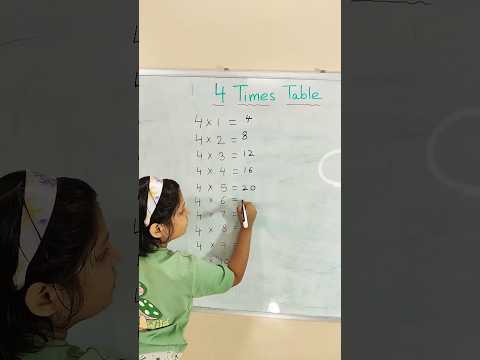
Subscribe to our ▶️ YouTube channel 🔴 for the latest videos, updates, and tips.
Skip Counting by 4s
Skip counting means counting forward by the same number again and again. For the 4 times table, we add 4 each time.
The 4s Skip-Counting Sequence
0, 4, 8, 12, 16, 20, 24, 28, 32, 36, 40, 44, 48
Remember
- Each number is 4 more than the previous number.
- All the numbers are multiples of 4.
- The pattern continues: 52, 56, 60, 64, and so on.
4 Times Table on a Number Line
Count the jumps from 0 to 12. Each step represents one more group of 4 in the 4 times table.
4 Times Table on a Interactive Number Line
Practice the 4 Times Table
Practice your multiplication facts by finding the missing products and missing numbers. Try each question yourself before revealing the answer. Use these activities to build confidence and improve your multiplication skills!
Practice 1: Fill in the Missing Products
Multiply the numbers and find the missing product. Think of the answer before clicking "Show Answer."
Practice 2: Find the Missing Number
Find the missing factor. Remember that multiplication can be used to find the total number of objects in equal groups.
Learning Tip: If you forget an answer, count by 4s or use the number line above. Practice a few facts each day to help you remember the 4 times table.
Interactive 4 Times Table Flashcards
Tap or click the card to reveal the answer. Practise all 12 facts!
Interactive 4 Times Table Quiz
Test your multiplication skills! Answer 10 questions about the 4 times table and see how well you do.
1 / 10
0 / 10
4 × 1 = ?
Choose the correct answer below.
Quiz Complete!
Your final score is:
Answer Review
Review your answers and check the correct products.
| Question | Your Answer | Correct Answer | Result |
|---|
4 Times Table Word Problems
Use the 4 times table to solve these everyday math problems. Enter a number, check your answer, and learn from the solution.
Problem 1: Pencils
Mia has 4 boxes of pencils. Each box contains 3 pencils. How many pencils does Mia have altogether?
4 × 3 = 12
Answer: 12 pencils.
Problem 2: Cupcakes
A baker puts 4 cupcakes on each plate. There are 5 plates. How many cupcakes are there altogether?
5 × 4 = 20
Answer: 20 cupcakes.
Problem 3: Toy Cars
Noah collects 4 toy cars every week for 7 weeks. How many toy cars does he collect?
7 × 4 = 28
Answer: 28 toy cars.
Problem 4: Classroom Chairs
A classroom has 9 rows with 4 chairs in each row. How many chairs are there altogether?
9 × 4 = 36
Answer: 36 chairs.
Problem 5: Sticker Packs
Emma buys 12 packs of stickers. Each pack contains 4 stickers. How many stickers does she buy?
12 × 4 = 48
Answer: 48 stickers.
Try each problem and check your answers.
4 Times Table Drag-and-Drop Game
4 Times Table Game
Drag an answer into the box, or tap an answer and then tap the box.
4 × 3 = ?
Choose an Answer
🎉 Game Complete!
Answer Review
| Question | Your Answer | Correct | Result |
|---|
Free 4 Times Table Printable Resources
Free Printable 4 Times Table | |
Blank 4 Times Table Chart |
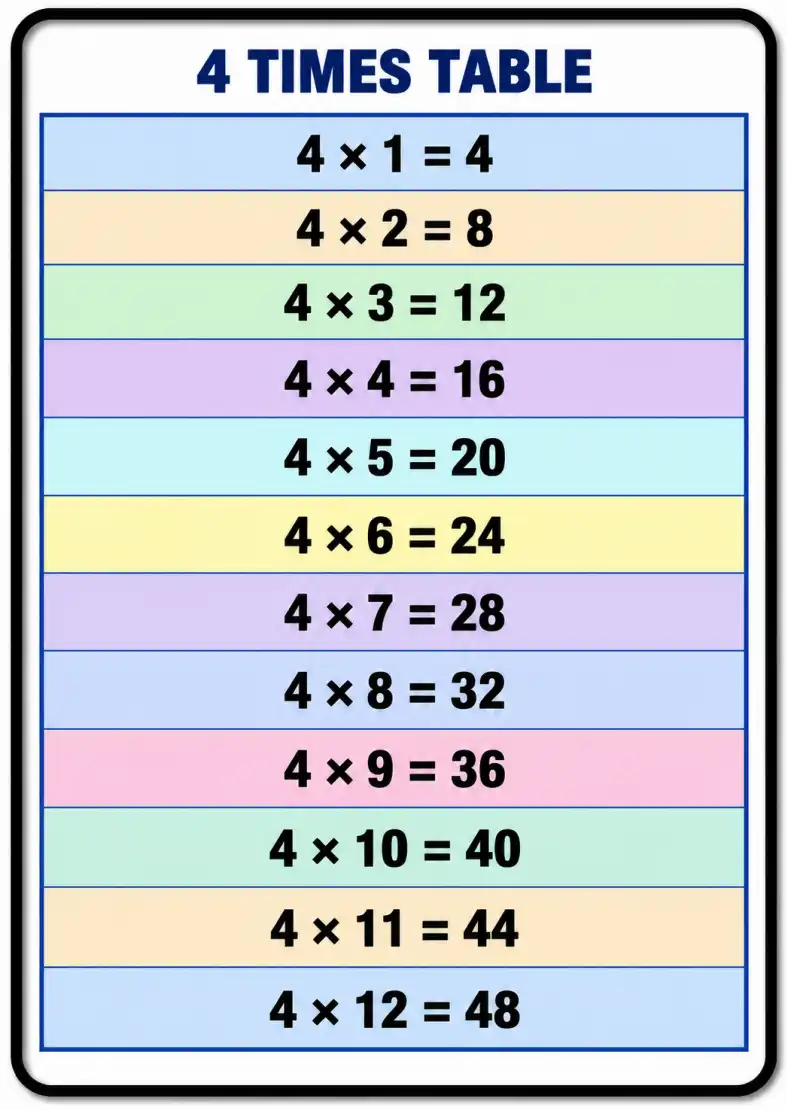
Printable 4 Times Table Worksheets
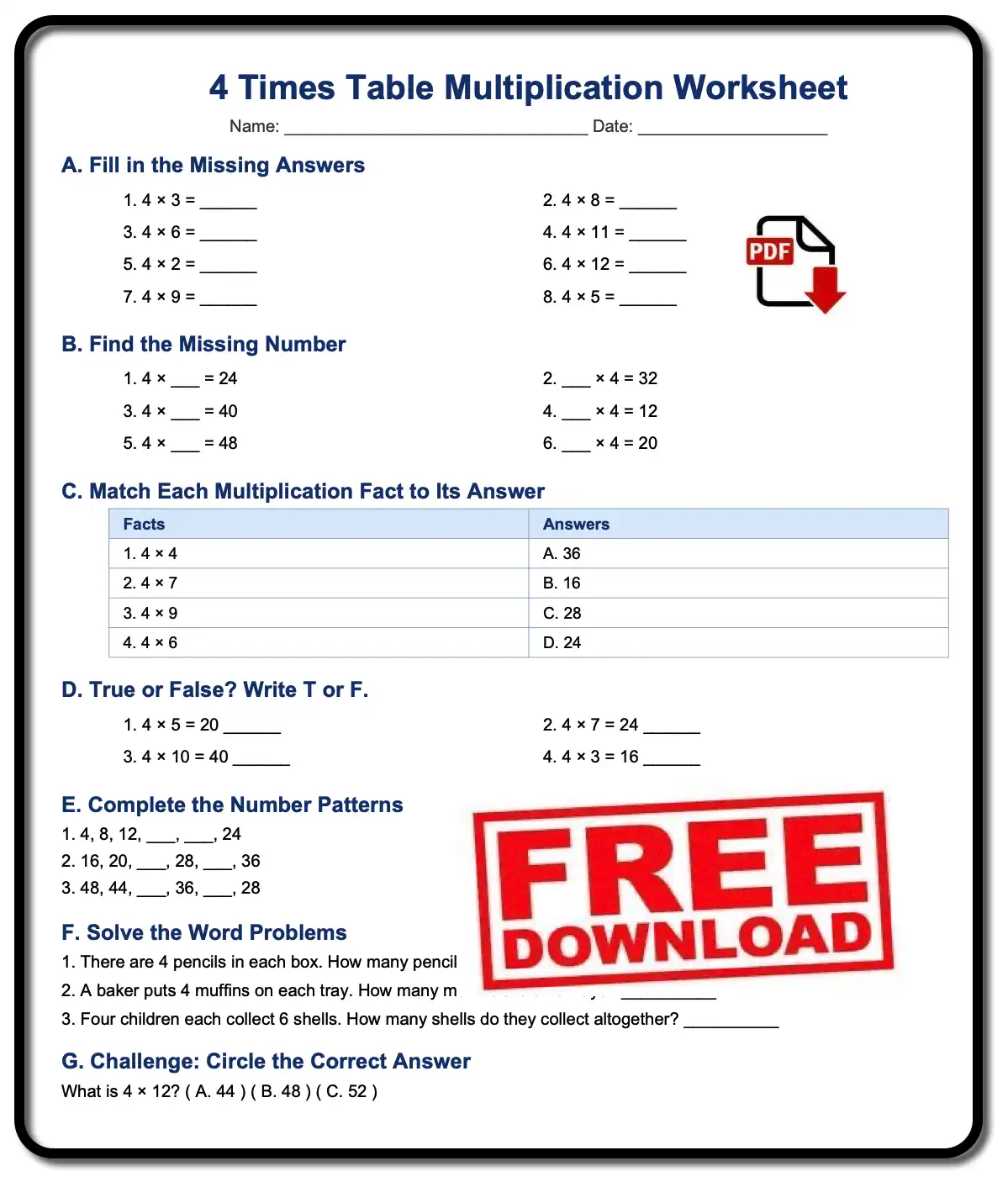
Let’s practice free multiplication table from the below exercise after learning 4 times table multiplication chart.
Worksheet + Answer Key |
Frequently Asked Questions About 4 Times Table Multiplication Chart
1. What is the 4 times table?
1. What is the 4 times table?
Answer:
4 times table is a list of multiplication facts showing what happens when you multiply a number by 4. It helps students understand how to find the total number of objects in 4 equal groups quickly.
2. How do you read a 4 times table equation?
2. How do you read a 4 times table equation?
Answer:
You read the multiplication sign (×) as "times" and the equals sign (=) as "equals." For example, 4 × 3 = 12 is read as "Four times three equals twelve."
3. What are the easiest ways to memorize the 4 times table?
3. What are the easiest ways to memorize the 4 times table?
Answer:
The most effective methods include skip counting by 4s (4, 8, 12, 16...), using repeated addition, doubling the 2 times table, or visualizing jumps of 4 on a number line.
4. How does doubling the 2 times table work?
4. How does doubling the 2 times table work?
Answer:
Because 4 is twice 2, you can find any 4 times table fact by taking the answer from the 2 times table and doubling it. For instance, to find 4 × 6, first do 2 × 6 = 12, and then double 12 to get 24.
5. What is repeated addition in the 4 times table?
5. What is repeated addition in the 4 times table?
Answer:
Multiplication by 4 can be solved by adding the number 4 repeatedly. For example, 4 × 5 is exactly the same as adding five 4s together: 4 + 4 + 4 + 4 + 4 = 20.
6. Are there any patterns in the 4 times table answers?
6. Are there any patterns in the 4 times table answers?
Answer:
Are there any patterns in the 4 times table answers?
Yes, there are several:
- Every answer increases by 4 each time.
- Every answer is an even number (none of them are odd).
- The last digits of the answers constantly repeat in this specific order: 4, 8, 2, 6, 0.
About Author

Written by Priyanka Ghosh
Mathematics Educator | Founder of Math Only Math
Priyanka Ghosh has been teaching elementary and middle-school mathematics for over 12 years and specializes in creating simple, child-friendly math lessons and worksheets.
Related Multiplication Resources
Explore More Times Tables
Ready to practice more multiplication facts? Explore these times tables to build your multiplication skills and improve your confidence with larger numbers.
0 - 25 Multiplication Times Table Chart
Multiplication Table Worksheets
From 4 Times Table Multiplication Chart to HOME PAGE
Didn't find what you were looking for? Or want to know more information about Math Only Math. Use this Google Search to find what you need.



