Subscribe to our ▶️ YouTube channel 🔴 for the latest videos, updates, and tips.
Home | About Us | Contact Us | Privacy | Math Blog
Cube
If a number is multiplied by itself three times, then the product is called the cube of that number.
To denote the cube of a number, 3 is written a little up to the right of the numbers.
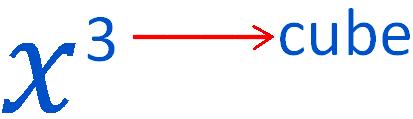
Thus, 3 is the power of x and is read as “x cubed”.
Cube of a number:
When a number is multiplied three times by itself, the product obtained is called the cube of a number.
For a given numberm, we define, cube of m = m × m × m, denoted by m³.
For example:
(i) 2³ = (2 × 2 × 2) = 8.
Thus, cube of 2 is 8.
(ii) 3³ = (3 × 3 × 3) = 27.
Thus, cube of 3 is 27.
(iii) 4 × 4 × 4 = 64, here 64 is the cube of 4.
(iv) 5 × 5 × 5 = 125, here 125 is the cube of 5.
Perfect cube:
A natural number (n) is said to be a perfect cube if (n = m³) it is the cube of some natural number.
For example:
1³ =1,
2³ = 8,
3³ =27,
4³ =64,
5³ =125, etc.
Thus 1, 8, 27, 64, 125, etc. are perfect cubes.
A given natural number is a perfect cube if it can be expressed as the product of triplets of equal factors.
Cubes of negative integer:
The cube of a negative integer is always negative.
For example:
(-1)³ = (-1) × (-1) × (-1) = -1,
(-2)³ = (-2) × (-2) × (-2) = -8
(-3)³ = (-3) × (-3) × (-3) = -27, etc.
Cube of a rational number:
We have, (a/b) ³ = a/b × a/b × a/b = (a × a × a)/(b × b × b) = a³/b³
Hence, (a/b) ³ = a³/ b³
For example:
(i) (3/5) ³ = 3³/5 ³ = (3 × 3 × 3)/(5 × 5 × 5) = 27/125
(ii) (-2/3) ³ = (-2) ³/ 3³ = {(-2) × (-2) × (-2)}/(3 × 3 × 3) = -8/27
Properties of cubes of numbers:
(i) The cube of every even natural number is even.
(ii) The cube of every odd natural number is odd.
Solved example to find perfect cubes step by step;
1. Show that 189 is not a perfect cube.
Solution:
Resolving 189 into prime factors, we get:
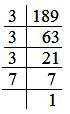
189 = 3 × 3 × 3 × 7
Making triplets, we find that one triplet is formed and we are left with one more factor.
Thus, 189 cannot be expressed as a product of triplets.
Hence, 189 is not a perfect cube.
2. Show that 216 is a perfect cube. Find the number whose cube is 216.
Solution:
Resolving 216 into prime factors, we get:
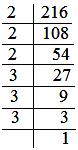
216 = 2 × 2 × 2 × 3 × 3 × 3
= (2 × 3) × (2 × 3) × (2 × 3)
= (6 × 6 × 6)
= 6³
Thus, 216 is a perfect cube.
And, 6 is the number whose cube is 216.
3. What is the smallest number by which 3087 may be multiplied so that the product is a perfect cube?
Solution:
Writing 3087 as a product of prime factors, we have:
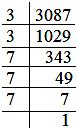
3087 = 3 × 3 × 7 × 7 × 7
Hence, to make it a perfect cube, it must be multiplied by 3.
4. What is the smallest number by which 392 may be divided so that the quotient is a perfect cube?
Solution:
Writing 392 as a product of prime factors, we have:
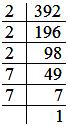
392 = 2 × 2 × 2 × 7 × 7
Clearly, to make it a perfect cube, it must be divided by (7 × 7), i.e., 49.
5. Find the cube of each of the following :
(i) (-70 ) (ii) 1²/₃ (iii) 2.5 (iv) 0.06
Solution:
(i) (-7)³
= (-7) × (-7) × (-7)
= -343
(ii) (1²/₃)³
= (5/3) ³
= 5³/3³
= (5 × 5 × 5)/(3 × 3 × 3)
= 125/27
(iii) (2.5)³
= (25/10)³
= (5/2)³
= 5³/3³
= (5× 5 × 5)/(3× 3× 3)
= 125/27
(iv) (0.06) ³
= (6/100)³
= (3/50)³ = 3³/(50)³
= (3 × 3 × 3)/(50 × 50 × 50)
= 27/125000
● Cube and Cube Roots
To Find if the Given Number is a Perfect Cube
Method for Finding the Cube of a Two-Digit Number
● Cube and Cube Roots - Worksheets
Worksheet on Cube and Cube Root
8th Grade Math Practice
From Cube to HOME PAGE
Didn't find what you were looking for? Or want to know more information about Math Only Math. Use this Google Search to find what you need.

Recent Articles


-
Worksheet on Area, Perimeter and Volume | Square, Rectangle, Cube,Cubo
Jul 25, 25 12:21 PM
In this worksheet on area perimeter and volume you will get different types of questions on find the perimeter of a rectangle, find the perimeter of a square, find the area of a rectangle, find the ar… -
Worksheet on Volume of a Cube and Cuboid |The Volume of a RectangleBox
Jul 25, 25 03:15 AM
 We will practice the questions given in the worksheet on volume of a cube and cuboid. We know the volume of an object is the amount of space occupied by the object.1. Fill in the blanks:
 -
Volume of a Cuboid | Volume of Cuboid Formula | How to Find the Volume
Jul 24, 25 03:46 PM
 Cuboid is a solid box whose every surface is a rectangle of same area or different areas. A cuboid will have a length, breadth and height. Hence we can conclude that volume is 3 dimensional. To measur…
 -
Volume of a Cube | How to Calculate the Volume of a Cube? | Examples
Jul 23, 25 11:37 AM
 A cube is a solid box whose every surface is a square of same area. Take an empty box with open top in the shape of a cube whose each edge is 2 cm. Now fit cubes of edges 1 cm in it. From the figure i…
 -
5th Grade Volume | Units of Volume | Measurement of Volume|Cubic Units
Jul 20, 25 10:22 AM
 Volume is the amount of space enclosed by an object or shape, how much 3-dimensional space (length, height, and width) it occupies. A flat shape like triangle, square and rectangle occupies surface on…
New! Comments
Have your say about what you just read! Leave me a comment in the box below. Ask a Question or Answer a Question.