Subscribe to our ▶️ YouTube channel 🔴 for the latest videos, updates, and tips.
Indian Number System vs International Number System
The Indian and International Number System are two methods used to read, write, and represent large numbers. Both systems use the same digits (0–9), but they differ in the way commas are placed and in the names given to large place values. Students learn these numbering systems to read big numbers correctly, write number names accurately, and solve mathematics problems with confidence. The Indian Number System is mainly used in India, Nepal, Bangladesh, Pakistan, and Sri Lanka, where terms such as lakh and crore are commonly used. The International Number System is used in most other countries, including the United States, the United Kingdom, Canada, Australia, and many European nations, where terms like million, billion, and trillion are standard. Comparing both systems helps students understand the differences in comma placement and place value names, making it easier to convert numbers, interpret textbooks and newspapers, and communicate numerical information accurately in both national and international contexts.
To read the larger numbers easily, we group their places into the periods.
A numeral system (or number system) is a writing system for expressing number i.e., a mathematical notation for representing numbers using digits or other symbols.
There are two commonly used number systems, i.e., Indian Number System and International Number System.
🇮🇳 Indian conversion → 🌎 International: Calculator
🌎 International → 🇮🇳 Indian conversion: Calculator
Indian Number System:
A numeration table gives the respective names of places of figures representing the number.
In Indian Number System, we use the places like ones, tens, hundreds, thousands, lakh crores, arabs, etc. Further, these places are grouped into the periods, i.e., Ones, Thousands, Lakhs, Crores, Arabs, etc. The ones period has three places, i.e., ones, tens, hundreds. The remaining periods have two places each as given below in the Indian Place Value Chart.
Indian Place Value Chart:
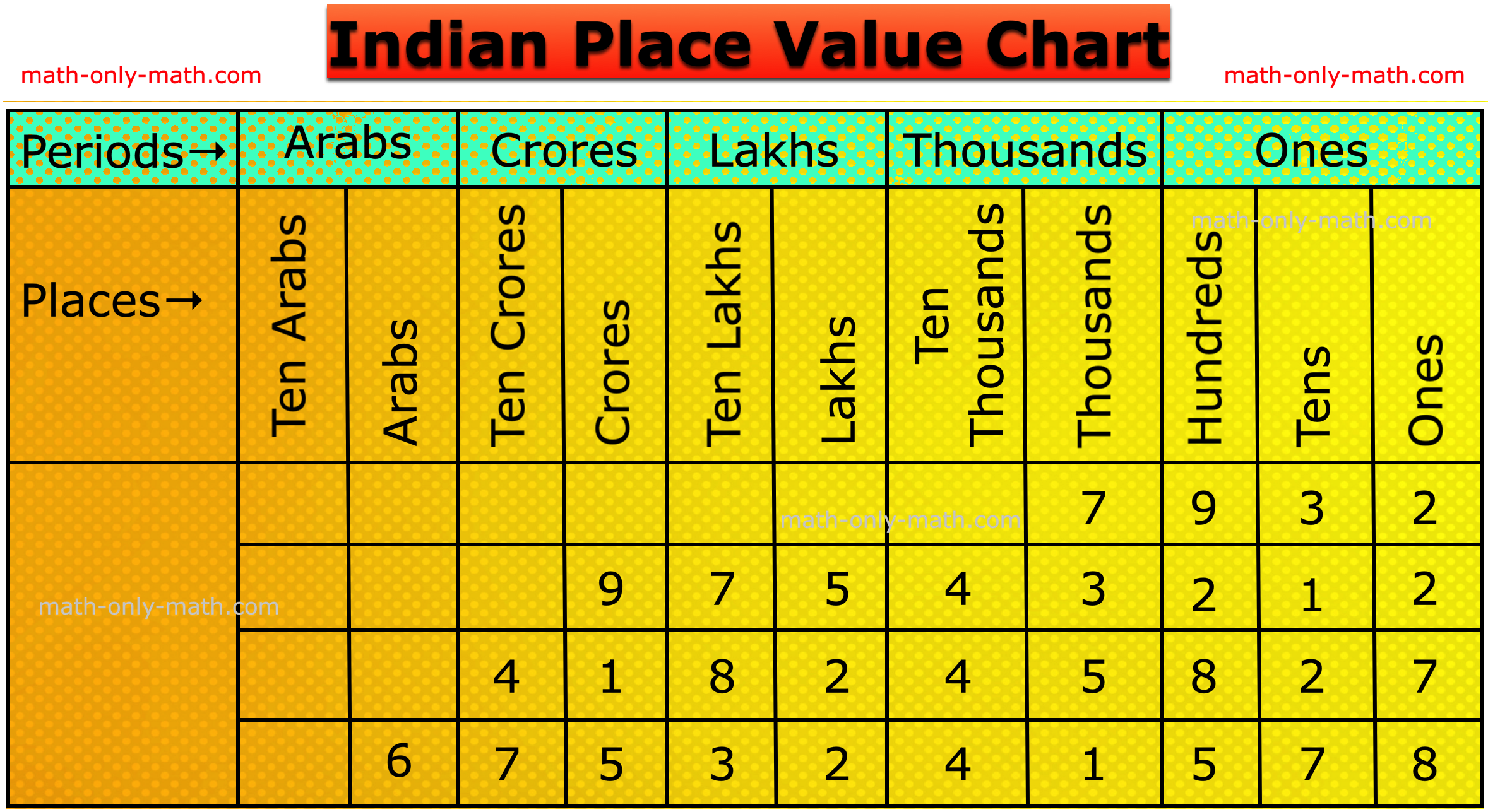
Commas (,) are used to mark the periods such as thousands, lakhs, crores, and arabs. In a large number, the first comma is placed just after the thousands digit, second comma just after the lakhs digit, third comma just after the crores digit, so on.
Note:
While writing number names, we do not use commas.
For example:
(a) The number 7932 is read as "seven thousand nine hundred thirty-two" and is written as 7,932
(b) The number 97543212 is read as "nine crore seventy-five lakh forty-three thousand two hundred twelve" and is written as 9,75,43,212.
(c) The number 418245827 is read as "forty-one crore eighty-two lakh forty-five thousand eight hundred twenty-seven" and is written as 41,82,45,827.
(d) The number 6753241578 is read as "six arab seventy-five crore thirty-two lakh forty-one thousand five hundred seventy-eight" and is written as 6,75,32,41,578.
International Number System:
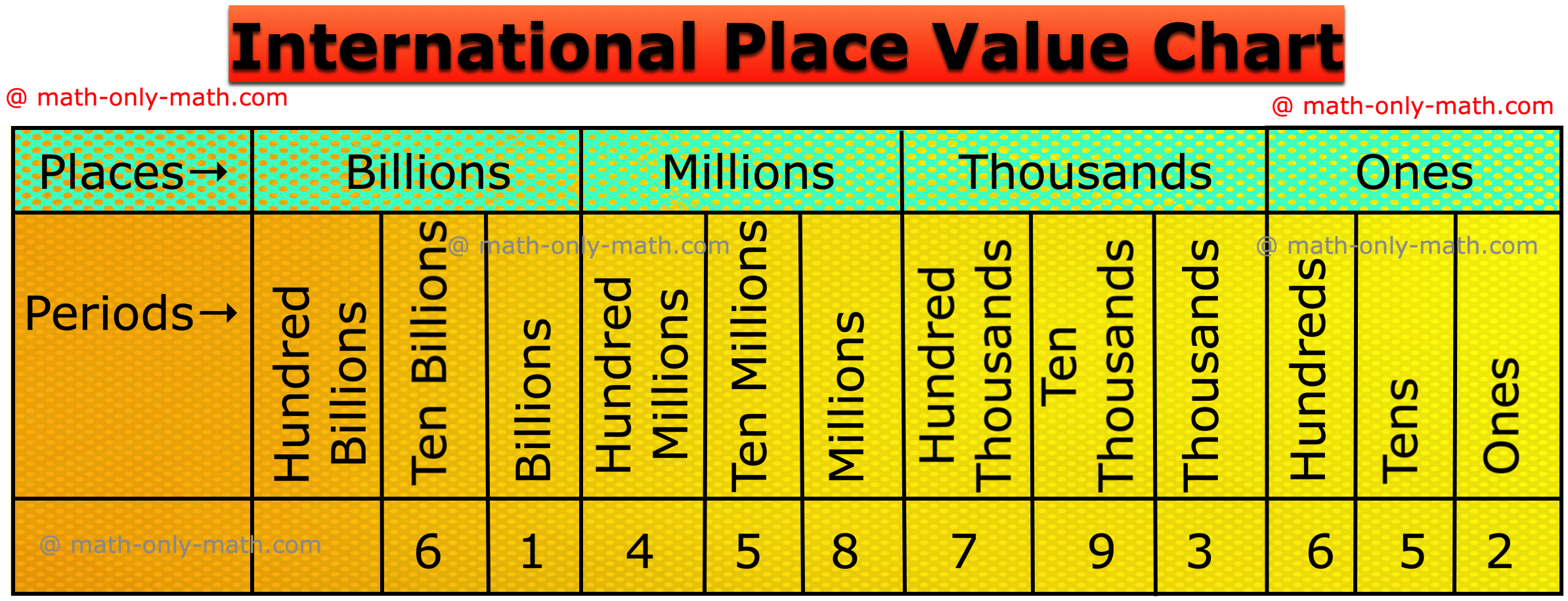
In the International System of Numeration, as it is being used, we have the periods such as the ones, thousands, millions and then billions as given in the next page in a table. Each period has three places
Commas are used to mark the periods of thousands, millions, billions, etc. A comma comes after every three digits from the right. The first comma marks thousands, the next comma marks millions, and the next billions.
For example, the number 61458793652 in this system is read as "sixty-one billion four hundred fifty-eight million seven hundred ninety-three thousand six hundred fifty-two" and is written as 61,458,793,652.
International Place Value Chart:
Calculator: Indian to International Number System Converter:
🔢 Indian to International Number System Converter
Enter a number written in the Indian Numbering System and instantly see how it is written with commas in the International Numbering System.
🇮🇳 Indian Numbering System
🌎 International Numbering System
12,34,56,789 → 123,456,789
Comparison of Indian and International Number System: (Indian vs International System)
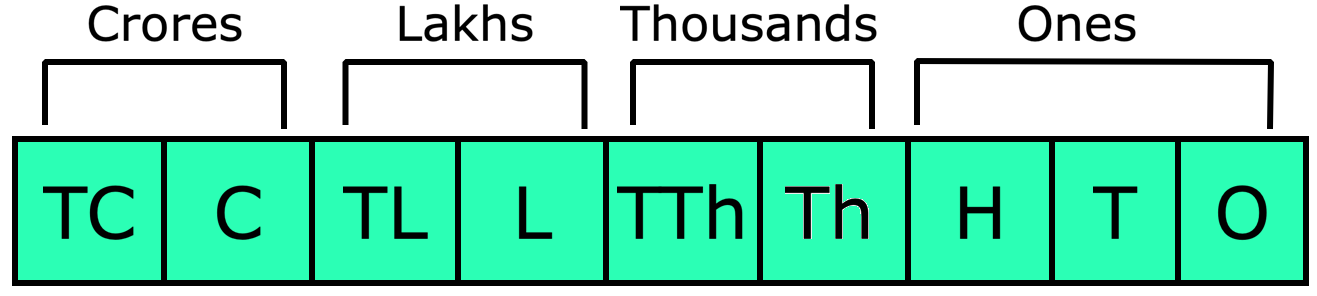
The Indian System has periods Ones, Thousands, Lakhs, Crores.
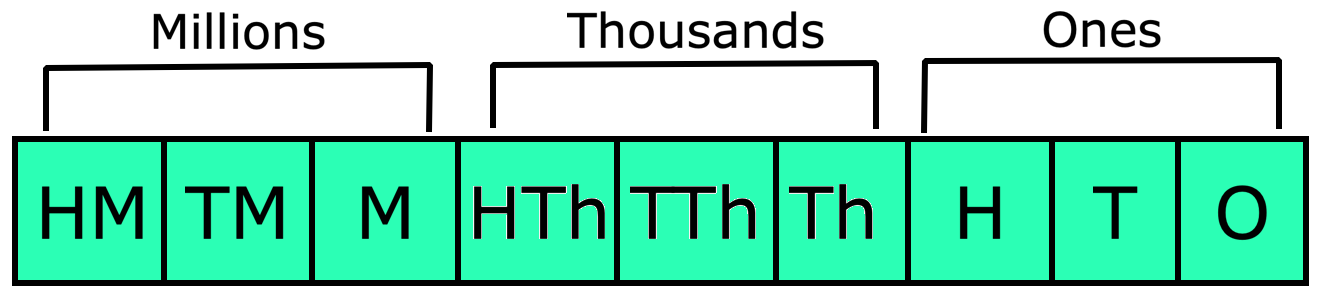
The International System has periods Ones, Thousands, Millions.
In Indian Place Value Chart, the Ones period has three places and all other periods have two places each.
In International Place Value Chart, all the periods have three places each. We put commas (,) in the numerals and write number names accordingly as per the periods.
On comparing these two systems of numeration, we have the following relations:
1 hundred thousand = 1 lakh
1 million 10 lakhs
10 millions= 1 crore
1 billion 100 crores
10 billions 1000 crores
Calculator: International to Indian Number System Converter:
🔢 International to Indian Number System Converter
Enter a number written in the International Numbering System and instantly convert it to the Indian Numbering System.
🌎 International Numbering System
🇮🇳 Indian Numbering System
123,456,789 → 12,34,56,789
Indian vs International Number System Comparison Table:
Difference Between Indian and International Number System
Compare the place values and number names used in both numbering systems.
| Indian Number System | International Number System |
|---|---|
| Thousand | Thousand |
| Ten Thousand | Ten Thousand |
| Lakh (1,00,000) | Hundred Thousand (100,000) |
| Ten Lakh (10,00,000) | One Million (1,000,000) |
| Crore (1,00,00,000) | Ten Million (10,000,000) |
| Ten Crore (10,00,00,000) | One Hundred Million (100,000,000) |
| Arab (1,00,00,00,000) | One Billion (1,000,000,000) |
- 1 Million = 10 Lakhs
- 1 Crore = 10 Million
- 1 Billion = 100 Crores
- Indian Number System uses lakh and crore.
- International Number System uses million and billion.
- Indian comma placement: 12,34,56,789 (groups digits as 3,2,2,2...)
- International comma placement: 123,456,789 (groups digits as 3,3,3...)
- The Indian system is mainly used in India, while the International system is used in most other countries.
Play Indian vs International Number System Game:
Indian & International Number System
Drag the correct answer into the box — tap an answer on mobile.
🎉 Game Complete!
| # | Question | Your Answer | Correct Answer | Result |
|---|
Solved Examples on Indian and International Number System:
1. Write the numbers in words in the Indian System of Numeration:
(a) 37,54,505
(b) 5,62,58,270
(c) 34,56,28,179
(d) 8,76,47,43,213
Solution:
(a) Thirty-seven lakh fifty-four thousand five hundred five.
(b) Five crore sixty-two lakh fifty-eight thousand two hundred seventy.
(c) Thirty-four crore fifty-six lakh twenty-eight thousand one hundred seventy-nine.
(d) Eight arab seventy-six crore forty-seven lakh forty-three thousand two hundred thirteen.
2. Write the numbers in words in the International System of Numeration:
(a) 767,259,845
(b) 645,628,177
(c) 4,427,478,784
(d) 8,439,645,619
Solution:
(a) Seven hundred sixty-seven million two hundred fifty-nine thousand eight hundred forty-five.
(b) Six hundred forty-five million six hundred twenty-eight thousand one hundred seventy-seven.
(c) Four billion four hundred twenty-seven million four hundred seventy-eight thousand seven hundred eighty-four.
(d) Eight billion four hundred thirty-nine million six hundred forty-five thousand six hundred nineteen.
3. Write the number 64301927 in both Indian and International number system using commas. Also, write their number names.
Solution:
In Indian System, 64301927 → 6,43,01,927
Number name - Six crore forty-three lakh one thousand nine hundred twenty-seven.
In International System, 64301927 → 64,301,927
Number name - Sixty-four million three hundred one thousand nine hundred twenty-seven.
Indian vs International Number System Quiz:
Indian and International Number System Quiz
Test your knowledge of Indian and International number systems.
Quiz Complete!
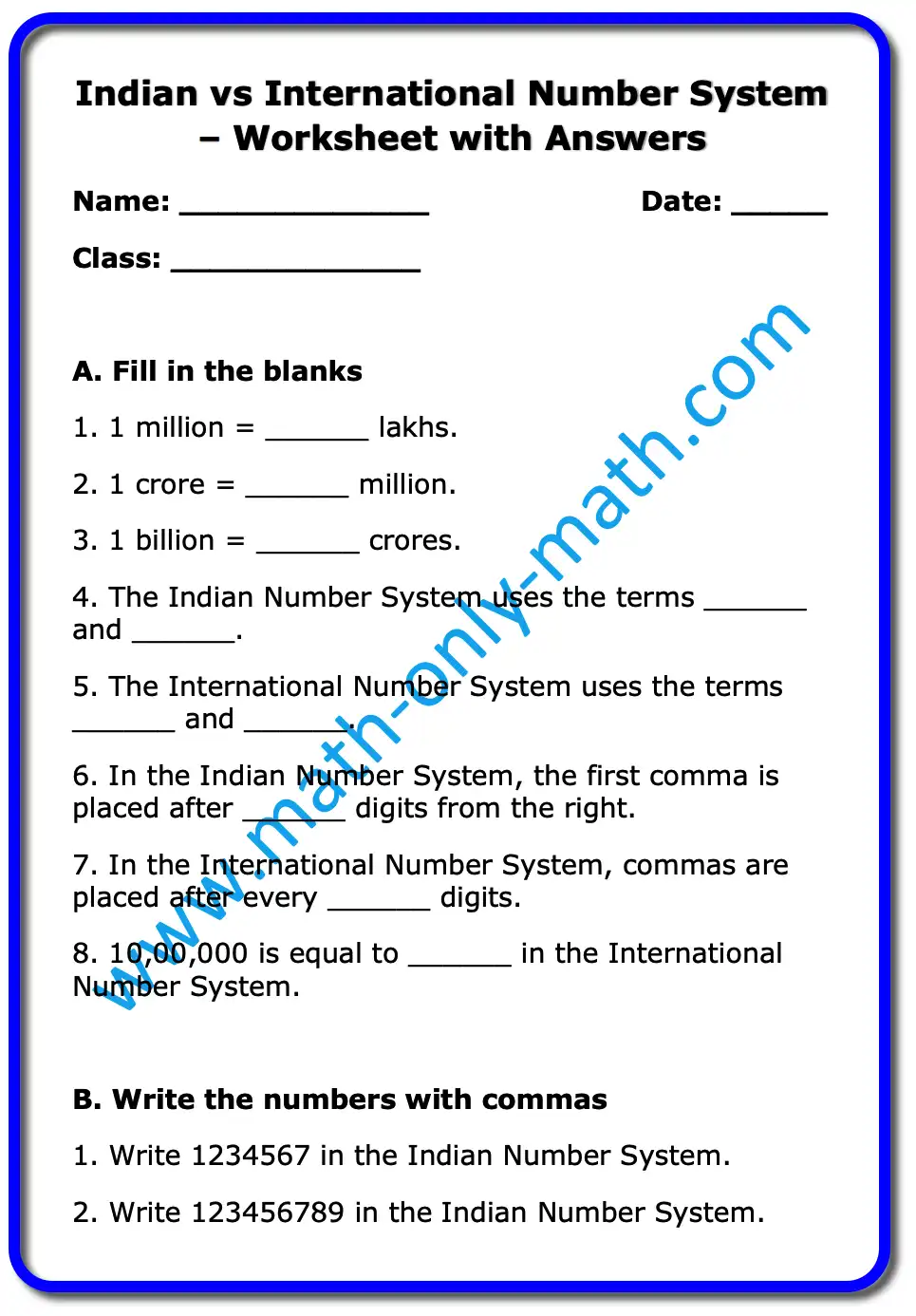
Indian and International Number System Worksheet:

Frequently Asked Questions (FAQs) on Indian vs International Number System:
1. What is the Indian Number System?
1. What is the Indian Number System?
Answer:
The Indian Number System is a method of writing and reading large numbers using place values such as thousand, lakh, crore, and arab. Digits are grouped with commas as 3,2,2,2...from right side, for example, 12,34,56,789.
2. What is the International Number System?
2. What is the International Number System?
Answer:
The International Number System is used in many countries around the world. It groups digits in sets of three from right to left and uses place values such as thousand, million, billion, and trillion. For example, 123,456,789.
3. What is the difference between the Indian and International Number System?
3. What is the difference between the Indian and International Number System?
Answer:
The main difference is the comma placement and the names of large place values. The Indian system uses lakh and crore, while the International system uses million and billion.
4. How many lakhs make 1 million?
4. How many lakhs make 1 million?
Answer:
1 million = 10 lakhs.
For example:
1,000,000 = 10,00,000
5. How many crores make 1 billion?
5. How many crores make 1 billion?
Answer:
1 billion = 100 crores.
For example:
1,000,000,000 = 100,00,00,000
6. How are commas placed in the Indian Number System?
6. How are commas placed in the Indian Number System?
Answer:
In the Indian Number System, the first comma is placed after three digits from the right, and then every two digits after that.
Example:
12,34,56,789
7. How are commas placed in the International Number System?
7. How are commas placed in the International Number System?
Answer:
In the International Number System, commas are placed after every three digits from the right.
Example:
123,456,789
8. What is a place value chart?
8. What is a place value chart?
Answer:
A place value chart is a table that shows the value of each digit in a number according to its position. It helps students read, write, compare, and understand large numbers correctly. In the Indian Number System, the chart includes ones, tens, hundreds, thousands, lakhs, crores, and arabs. In the International Number System, it includes ones, tens, hundreds, thousands, millions, billions, and trillions. A place value chart makes it easier to identify each digit's value and write numbers accurately.
About Author

Written by Priyanka Ghosh
Mathematics Educator | Founder of Math Only Math
Priyanka Ghosh has been teaching elementary and middle-school mathematics for over 12 years and specializes in creating simple, child-friendly math lessons and worksheets.
Share Feedback, Your Math Solution, Trick, or Classroom Activity!
Share your review, tip or ideas with thousands of students, parents, and teachers around the world.
You might like these
Word Problems on Addition and Subtraction Worksheet with Answers | PDF
Practice solving addition and subtraction word problems with this free printable worksheet. Includes answers, PDF download and easy questions for Grade 3, Grade 4 and Grade 5 students.
Estimating Products – Multiplication Estimation with Rounding, Quiz
Learn how to estimate products by rounding numbers to the nearest ten, hundred, or thousand. Includes step-by-step examples, word problems, worksheets, practice questions, and printable activities for students.
4th Grade Numbers Worksheets | Place Value Chart | Expended Form
In 5th Grade Numbers Worksheets we will solve how to read and write large numbers, use of place value chart to write a number in expanded form, represent the large number on the abacus, write the number in standard form, compare with another number and arrange numbers


From Indian and International Number System to HOME PAGE
Didn't find what you were looking for? Or want to know more information about Math Only Math. Use this Google Search to find what you need.



