Subscribe to our ▶️ YouTube channel 🔴 for the latest videos, updates, and tips.
Comparing and Ordering Fractions Worksheet
Comparing and ordering fractions worksheet helps students practice comparing and ordering fractions in a simple and engaging way. Learners will compare fractions using the symbols >, <, and =, identify the greater or smaller fraction, and arrange fractions in ascending and descending order. The worksheet includes a mix of like fractions, unlike fractions to build strong conceptual understanding. It supports the development of number sense, critical thinking, and confidence with fractions. This worksheet ideal for Grade 3 to 6, test preparation, and daily math practice.
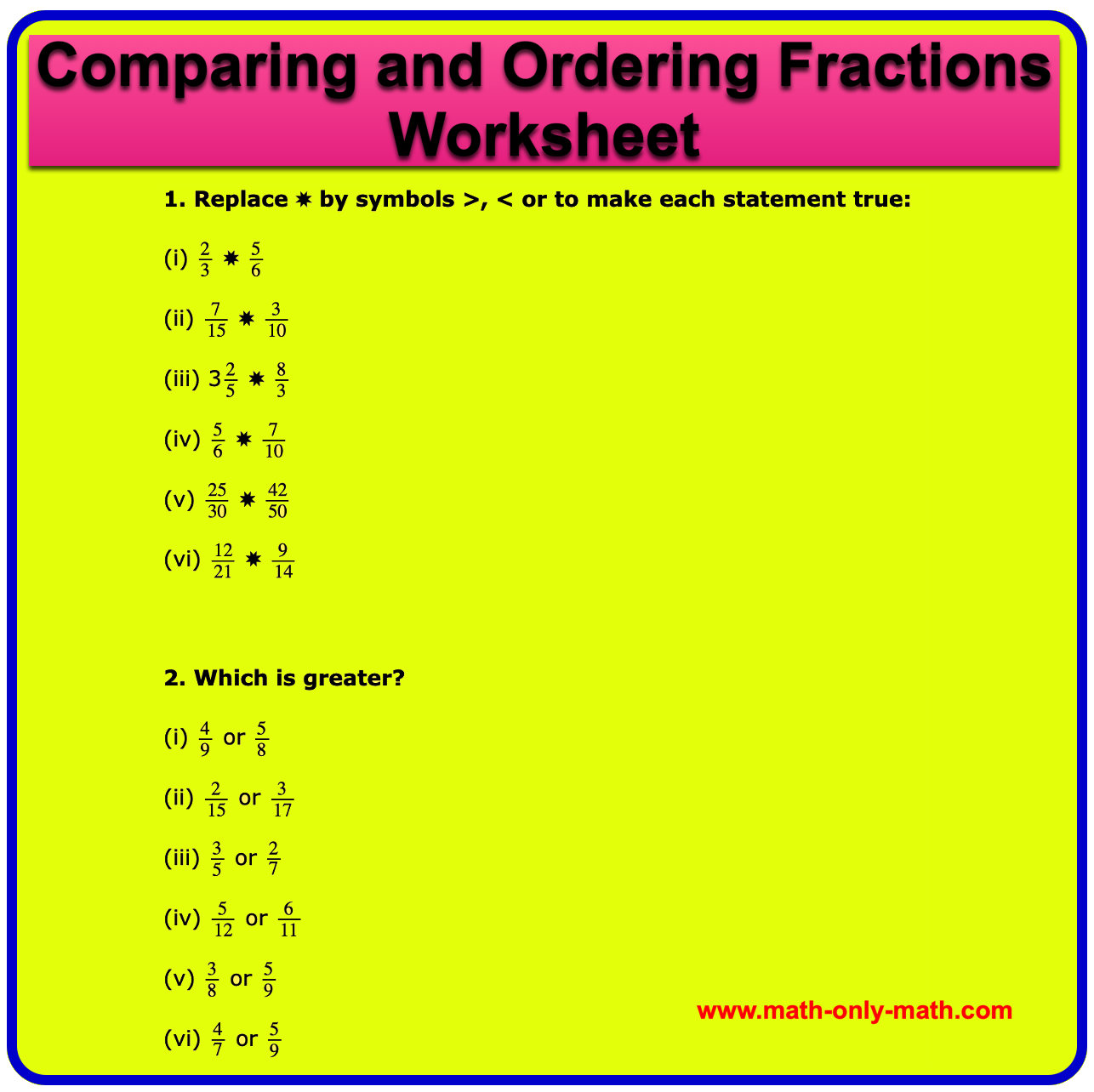
1. Replace ✸ by symbols >, < or to make each statement true:
(i) \(\frac{2}{3}\) ✸ \(\frac{5}{6}\)
(ii) \(\frac{7}{15}\) ✸ \(\frac{3}{10}\)
(iii) 3\(\frac{2}{5}\) ✸ \(\frac{8}{3}\)
(iv) \(\frac{5}{6}\) ✸ \(\frac{7}{10}\)
(v) \(\frac{25}{30}\) ✸ \(\frac{42}{50}\)
(vi) \(\frac{12}{21}\) ✸ \(\frac{9}{14}\)
2. Which is greater?
(i) \(\frac{4}{9}\) or \(\frac{5}{8}\)
(ii) \(\frac{2}{15}\) or \(\frac{3}{17}\)
(iii) \(\frac{3}{5}\) or \(\frac{2}{7}\)
(iv) \(\frac{5}{12}\) or \(\frac{6}{11}\)
(v) \(\frac{3}{8}\) or \(\frac{5}{9}\)
(vi) \(\frac{4}{7}\) or \(\frac{5}{9}\)
3. Which is smaller?
(i) \(\frac{2}{3}\) or \(\frac{3}{4}\)
(ii) \(\frac{8}{15}\) or \(\frac{13}{17}\)
(iii) \(\frac{7}{11}\) or \(\frac{9}{13}\)
(iv) \(\frac{5}{7}\) or \(\frac{7}{8}\)
(v) \(\frac{3}{8}\) or \(\frac{4}{5}\)
(vi) \(\frac{7}{13}\) or \(\frac{5}{7}\)
4. Arrange the following fractions in ascending order:
(i) \(\frac{1}{4}\), \(\frac{7}{8}\), \(\frac{5}{12}\)
(ii) \(\frac{5}{6}\), \(\frac{1}{5}\), \(\frac{9}{10}\)
(iii) \(\frac{4}{5}\), \(\frac{8}{15}\), \(\frac{3}{10}\)
(iv) \(\frac{9}{16}\), \(\frac{3}{20}\), \(\frac{6}{7}\)
(v) \(\frac{1}{5}\), \(\frac{2}{3}\), \(\frac{7}{10}\), \(\frac{5}{6}\)
(vi) \(\frac{7}{8}\), \(\frac{3}{4}\), \(\frac{15}{16}\), \(\frac{11}{12}\)
5. Arrange the following fractions in descending order:
(i) \(\frac{3}{4}\), \(\frac{5}{6}\), \(\frac{7}{8}\)
(ii) \(\frac{2}{5}\), \(\frac{1}{9}\), \(\frac{3}{8}\)
(iii) \(\frac{2}{3}\), \(\frac{1}{5}\), \(\frac{9}{10}\)
(iv) \(\frac{5}{14}\), \(\frac{13}{28}\), \(\frac{17}{42}\)
(v) \(\frac{7}{15}\), \(\frac{9}{10}\), \(\frac{8}{9}\), \(\frac{13}{18}\)
(vi) \(\frac{3}{11}\), \(\frac{5}{22}\), \(\frac{13}{33}\), \(\frac{21}{44}\)
6. In a restaurant at one table, a pizza was cut into 9 pieces and 4 of these were eaten. At another table, a pizza was cut into 11 pieces and 7 were eaten. Was more pizza eaten at the first table or the second?
7. Michael studied for \(\frac{3}{6}\) of an hour, while Elizabeth studied for \(\frac{3}{4}\) of an hour. Who studied, for a longer time?
8. In 10th standard, section-A of 40 students, 32 passed in first class; in section-B of 30 students, 25 passed in first class. In which section of 10th standard, was a greater fraction of students getting first class?
Comparing and Ordering Fractions Worksheet
Answer:
1. (i) <
(ii) >
(iii) >
(iv) >
(v) <
(vi) <
2. (i) \(\frac{5}{8}\)
(ii) \(\frac{3}{17}\)
(iii) \(\frac{3}{5}\)
(iv) \(\frac{6}{11}\)
(v) \(\frac{5}{9}\)
(vi) \(\frac{4}{7}\)
3. (i) \(\frac{2}{3}\)
(ii) \(\frac{8}{15}\)
(iii) \(\frac{7}{11}\)
(iv) \(\frac{5}{7}\)
(v) \(\frac{3}{8}\)
(vi) \(\frac{7}{13}\)
4. (i) \(\frac{1}{4}\) < \(\frac{5}{12}\) < \(\frac{7}{8}\)
(ii) \(\frac{1}{5}\) < \(\frac{5}{6}\) < \(\frac{9}{10}\)
(iii) \(\frac{3}{10}\) < \(\frac{8}{15}\) < \(\frac{4}{5}\)
(iv) \(\frac{3}{20}\) < \(\frac{9}{16}\) < \(\frac{6}{7}\)
(v) \(\frac{1}{5}\) < \(\frac{2}{3}\) < \(\frac{7}{10}\) < \(\frac{5}{6}\)
(vi) \(\frac{3}{4}\) < \(\frac{7}{8}\) < \(\frac{11}{12}\) < \(\frac{15}{16}\)
5. (i) \(\frac{7}{8}\) > \(\frac{5}{6}\) > \(\frac{3}{4}\)
(ii) \(\frac{2}{5}\) > \(\frac{3}{8}\) > \(\frac{1}{9}\)
(iii) \(\frac{9}{10}\) > \(\frac{2}{3}\) > \(\frac{1}{5}\)
(iv) \(\frac{13}{28}\) > \(\frac{17}{42}\) > \(\frac{5}{14}\)
(v) \(\frac{9}{10}\) > \(\frac{8}{9}\) > \(\frac{13}{18}\) > \(\frac{7}{15}\)
(vi) \(\frac{21}{44}\) > \(\frac{13}{33}\) > \(\frac{3}{11}\) > \(\frac{5}{22}\)
6. On the first table.
7. Elizabeth.
8. Section-B (\(\frac{5}{6}\))
From Comparing and Ordering Fractions Worksheet to HOME PAGE
Didn't find what you were looking for? Or want to know more information about Math Only Math. Use this Google Search to find what you need.


