Subscribe to our ▶️ YouTube channel 🔴 for the latest videos, updates, and tips.
6-Digit Numbers
Here we will learn 6-digit numbers, formation of 6-digit numbers, place value and face value of 6-digit numbers, successor of 6-digit numbers, predecessors of 6-digit numbers, the smallest 6-digit number and the greatest 6-digit number.
We know that 99999 is the greatest 5-digit number.
Now, let us see what number we get by adding 1 to it.
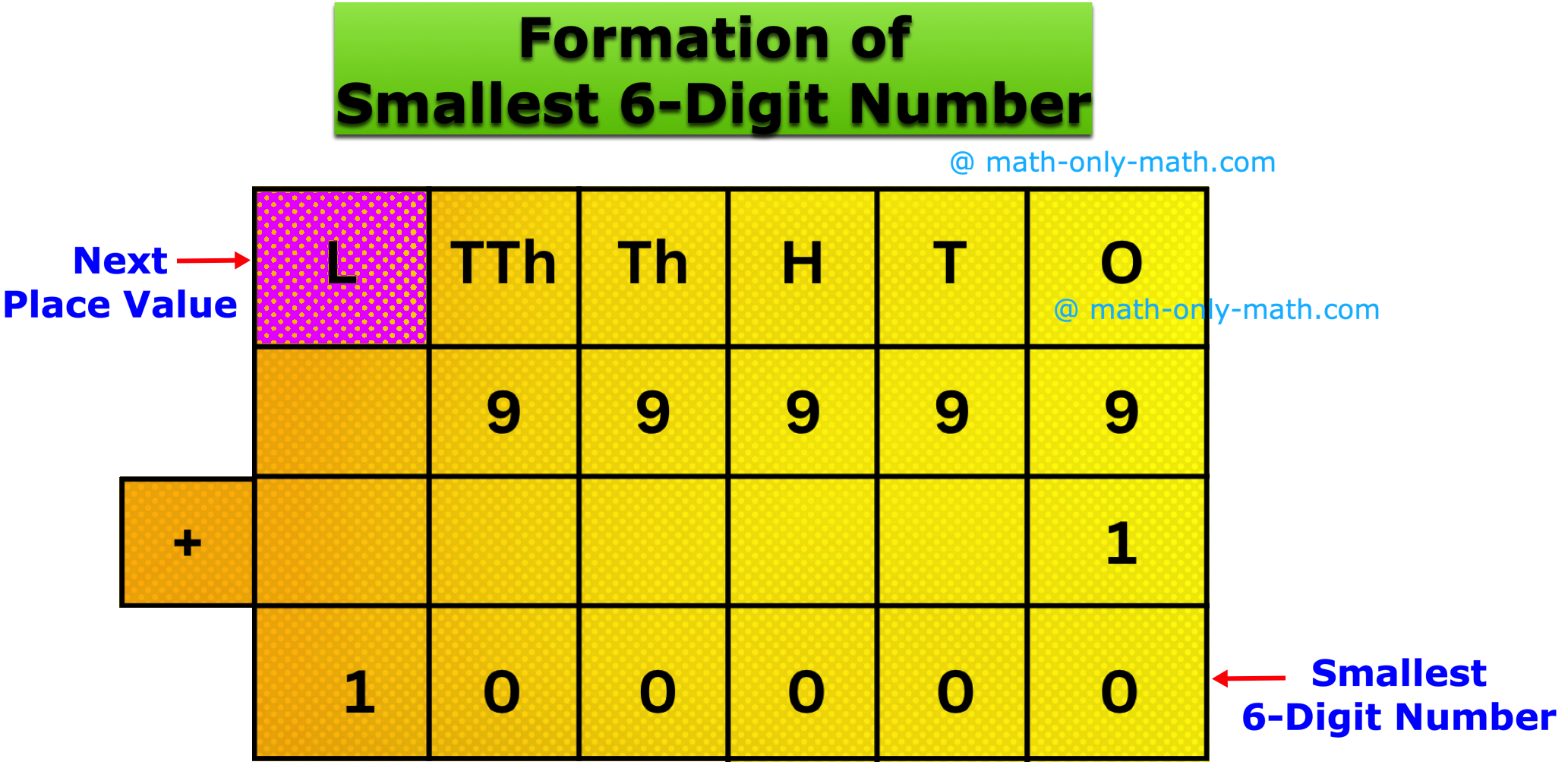
On adding 1 to 99999, we get 100000. We read it as ten thousand.
100000 is the smallest 6-digit number.
To write a 6-digit number, we take the next place value on left of thousands called Lakhs (L).
These 6-digit numbers after 10000 can be obtained by adding 1.
For example:
100000 + 1 = 100001 (One lakh one)
100001 + 1 = 100002 (One lakh two)
100002 + 1 = 100003 (One lakh three)
109999 + 1 = 110000 (One lakh ten thousand)
199999 + 1 = 200000 (Two lakh)
499999 + 1 = 500000 (Five lakh)
500000 + 1 = 500001 (Five lakh one)
999998 + 1 = 999999 (Nine lakh ninety-nine thousand nine hundred ninety-nine)
The greatest 6-digit number is 999999.
Place Value and Face Value of 6-Digit Numbers
What is Face Value of a 6-Digit Number?
The face value of a digit in a 6-digit number is the digit itself, regardless of its position in the number.
What is Place Value of a 6-Digit Number?
The place value of a digit depends on its position in the 6-digit number number.
The place value of a 6-digit number calculated
👉 Place Value = Digit × Value of the place it occupies.
Example of Place Value and Face Value of 6-Digit Numbers:
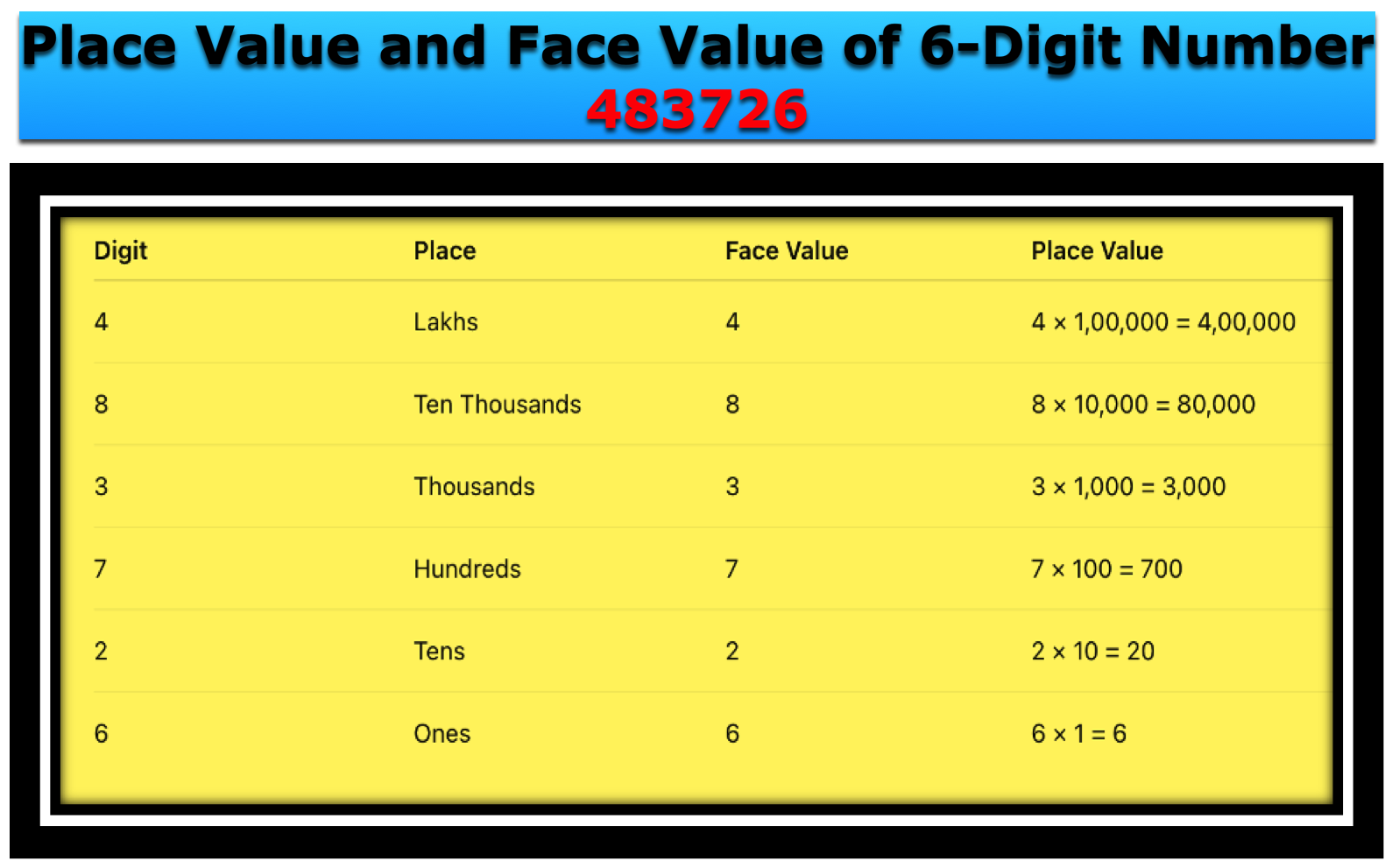
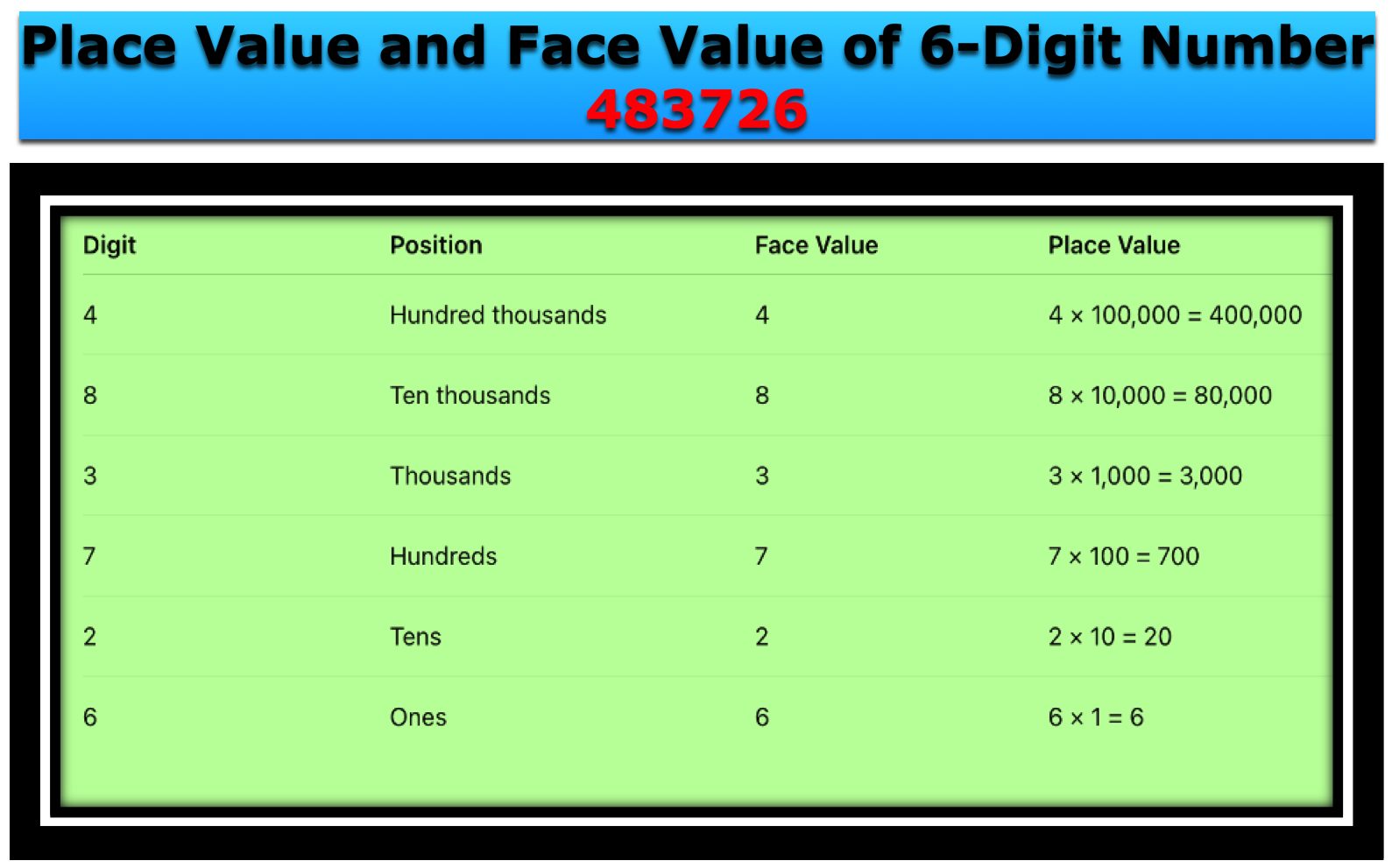
Let's take a 6-digit number 483726.
Place Value and Face Value of each digit of 483726:
Place Value and Face Value in International System
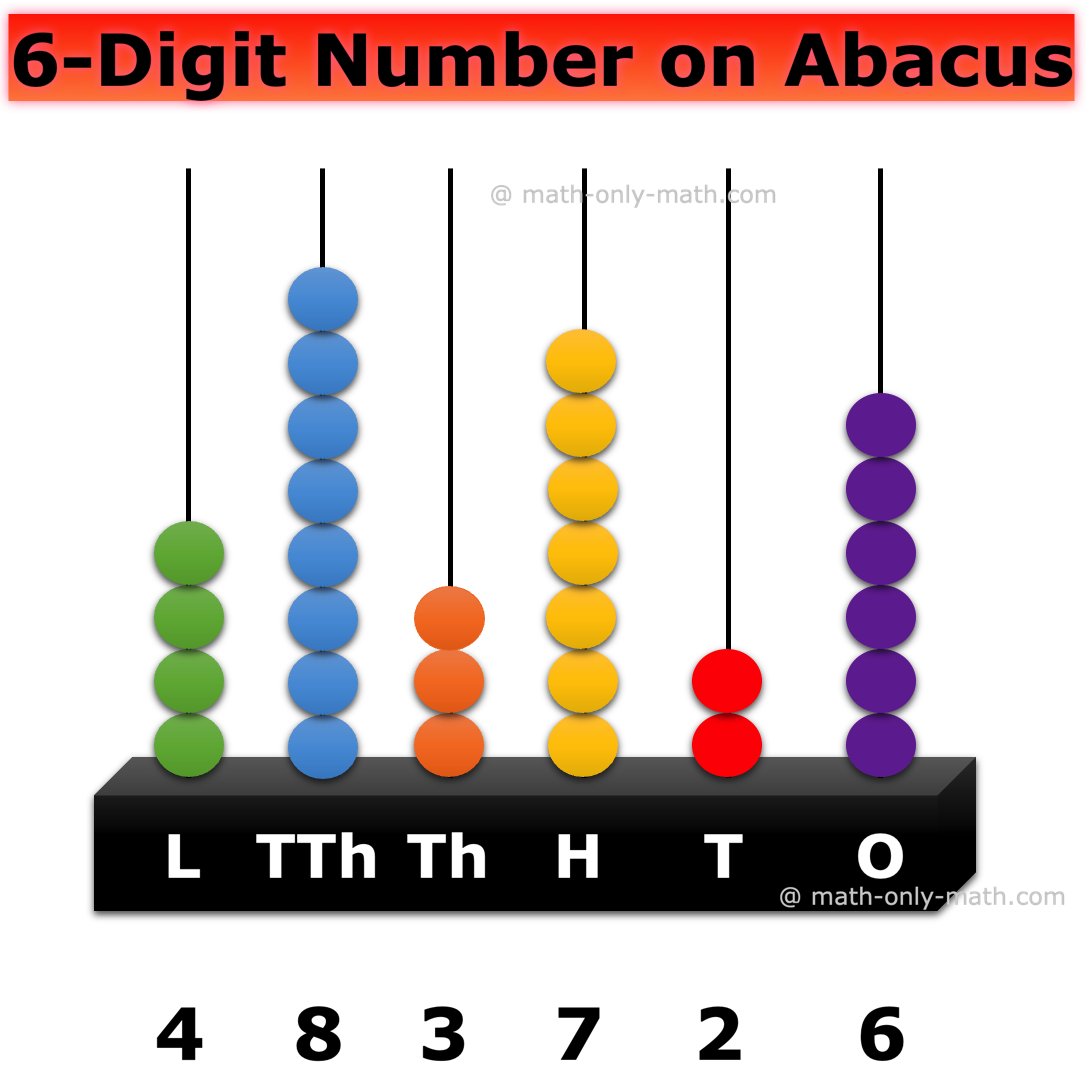
6-Digit Number on Abacus
We can represent a 6-digit number on an abacus using five place value columns:
|
Lakhs |
Ten-Thousands |
Thousands |
Hundreds |
Tens |
Ones |
Each column has beads that represent digits (0–9) in that specific place.
Let's Represent 483726 on an Abacus
Successor and Predecessor of 6-digit Numbers:
Successor of a 6-digit number is the number that comes immediately after a given 6-digit number.
The Rules to find the Successor of a 6-digit Number:
Successor of a 6-Digit number = Number + 1
👉 Successor = Number + 1
Predecessor of a 6-Digit Number is the number that comes immediately before a given 6-digit number.
The Rules to find the Predecessor of a 6-digit Number:
Predecessor of a 6-Digit number = Number - 1
👉 Predecessor = Number – 1
1. How many 6 digit numbers are there in maths?
1. How many 6 digit numbers are there in maths?
Answer
To find how many 6-digit numbers there are in maths, we need to count all the integers that have exactly 6 digits.
We know the
The smallest 6-digit number is 100000 and the largest 6-digit number is 999999.
Thus, the total number of 6-digit numbers is
999999 - 100000 + 1; (+ 1 because 10000 is the smallest 6-digit number)
= 899999 + 1
= 900000
Therefore are 900000 six-digit numbers in maths.
2. What is a 6 digit number example?
৬ অঙ্কের সংখ্যা কাকে বলে উদাহরণ দাও?
2. What is a 6 digit number example?
৬ অঙ্কের সংখ্যা কাকে বলে উদাহরণ দাও?
Answer
Example of a 6-digit number is 341508.
3. What are 6 digit numbers called?
3. What are 6 digit numbers called?
Answer
6 digit numbers are called 6-Digit Numbers.
4. What are the 6 digit numbers in the abacus?
4. What are the 6 digit numbers in the abacus?
Answer
Your answer is here: 6 Digits Number on Spike Abacus
From 6 Digits Numbers to HOME PAGE
Didn't find what you were looking for? Or want to know more information about Math Only Math. Use this Google Search to find what you need.



