Subscribe to our ▶️ YouTube channel 🔴 for the latest videos, updates, and tips.
5th Grade Worksheet on Prime and Composite Numbers
In 5th Grade Worksheet on Prime and Composite Numbers we will get different types of questions on prime numbers, even prime numbers, odd prime numbers, composite numbers, co-prime numbers, twin-prime numbers, prime-triple and perfect numbers.
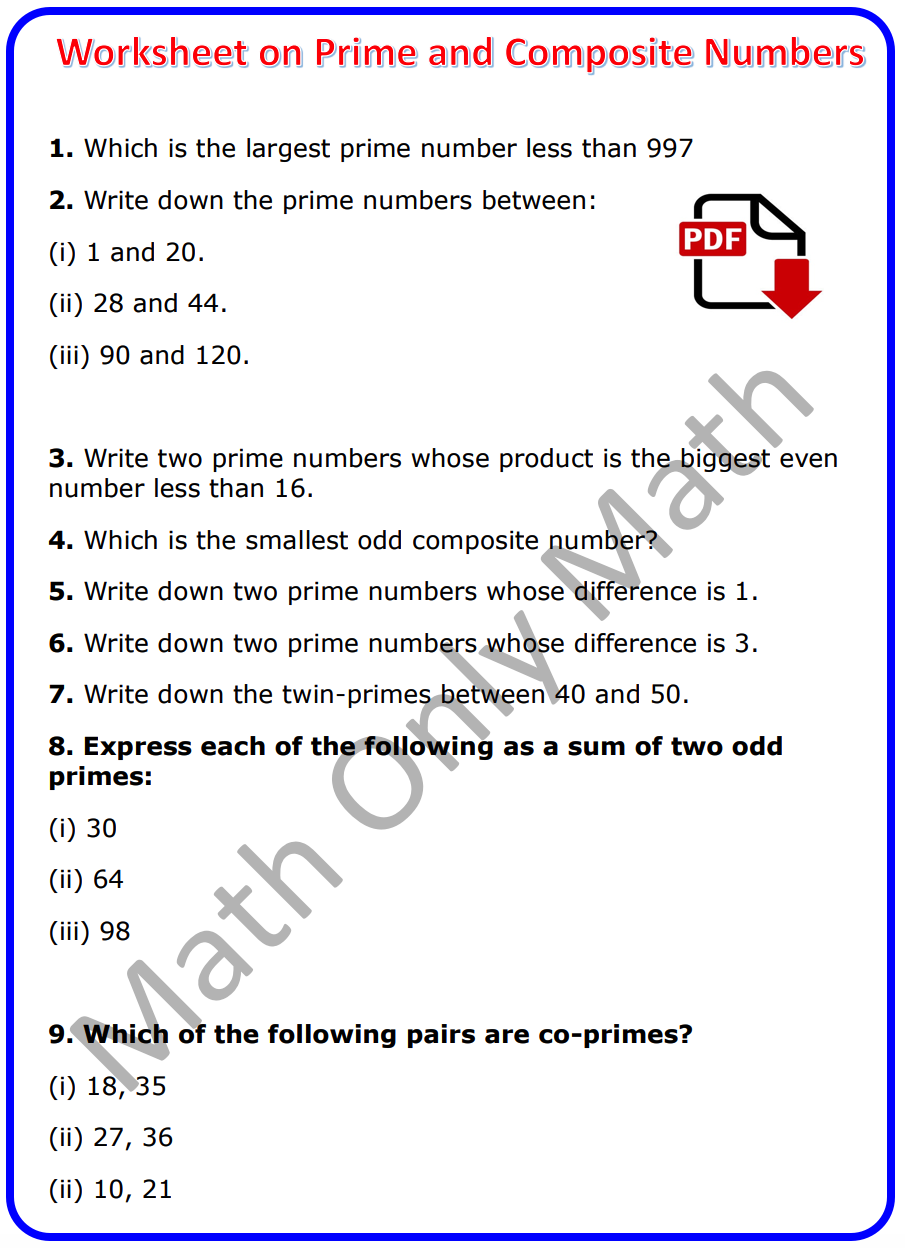
1. Which is the largest prime number less than 997
2. Write down the prime numbers between:
(i) 1 and 20.
(ii) 28 and 44.
(iii) 90 and 120.
3. Write two prime numbers whose product is the biggest even number less than 16.
4. Which is the smallest odd composite number?
5. Write down two prime numbers whose difference is 1.
6. Write down two prime numbers whose difference is 3.
7. Write down the twin-primes between 40 and 50.
8. Express each of the following as a sum of two odd primes:
(i) 30
(ii) 64
(iii) 98
9. Which of the following pairs are co-primes?
(i) 18, 35
(ii) 27, 36
(ii) 10, 21
10. Write 221 as a product of two prime numbers.
11. Find one perfect number between 1 and 30 except 6.
12. Write down all numbers less than hundred ending with 3. Separate them into prime and composite numbers.
13. Show that 1701 and 4400 are co-primes.
14. Stare whether true or false for the following statements:
(i) All prime numbers except 2 are even numbers.
(ii) 25 is an odd number but it is not a prime number.
(iii) 1 is a multiple of every natural number.
(iv) Two prime numbers are not necessary co-primes.
(v) A natural number greater than 1 is either a prime or has a factor which is prime.
15. Fill in the blanks.
(i) A number which has only two factors is called a ___________.
(ii) 1 is neither a nor a.... .......number.
(iii) Every number is a ___________ and ___________ of itself.
(iv) A number which having more than two factors is called ___________ number.
(v) is the smallest prime number.
(vi) ___________ ..... is the smallest composite number.
(vii) ___________ is the smallest even number.

16. Which of the following numbers are prime numbers?
(i) 53
(ii) 213
(iii) 149
(iv) 383
(v) 299
(vi) 577
(vii) 663
(viii) 263
17. Subtract 579 from 999. Then examine whether the result is prime or not.
18. Add 147 and 306 and find whether the result is prime or not.
19. Is 8893 a prime number? If yes, give reason.
Answer:
1. 97
2. (i) 2, 3, 5, 7, 11, 13, 17, 19
(ii) 29, 31, 37, 41, 43
(iii) 97, 101, 103, 107, 109, 113.
3. 2 and 7
4. 9
5. 2 and 3
6. 2 and 5
7. 41 and 43
8. (i) 13 and 17
(ii) 3 and 61
(iii) 19 and 79
9. (i) and (iii)
10. 13 x 17
11. 28
12. Prime: 3, 13, 23, 43, 53, 73, 83; Composite: 33, 63 and 93.
14. (i) False
(ii) True
(iii) False
(iv) False
(v) True.
15. (i) prime number
(ii) prime, composite
(iii) factor, multiple
(iv) composite
(v) 2
(vi) 4
(vii) 0
16. Prime numbers
(i) 53
(iii) 149
(iv) 383
(vi) 577
(viii) 263
17. Not
18. Not
19. Yes
From 5th Grade Worksheet on Prime and Composite Numbers to HOME PAGE
Didn't find what you were looking for? Or want to know more information about Math Only Math. Use this Google Search to find what you need.


