Subscribe to our ▶️ YouTube channel 🔴 for the latest videos, updates, and tips.
5th Grade Playing with Numbers Worksheet
In 5th Grade Playing with Numbers Worksheet we will get different types of problem on simplification of numerical operations, simplification of brackets, factors, multiples, finding prime and composite numbers, tests for divisibility, properties of divisibility, prime factorisation, finding the HCF by the prime factorisation method, finding the HCF by the division method, finding the LCM by the prime factorisation method, finding the LCM by the division method, relation between HCF and LCM and word problems on HCF and LCM.
🔴 A number that divides a given number exactly is called a factor of that number.
🔴 A number is a multiple of each of its factors.
🔴 Various types of numbers:
- Those natural numbers, which have only two factors, viz., 1 and the number itself, are called prime numbers
- Two natural numbers are called co-primes, if they have no common factors other than 1
- Two consecutive odd prime nurnbers are known as twin-primes.
- Numbers which have more than two factors are called composite numbers.
🔴 Prime factorisation means writing a number as a product of prime factors.
🔴 The HCF or GCD of two or more numbers is the greatest number, which is a common factor of all the given numbers.
🔴 The LCM of two or more numbers is the smallest number, which is a common multiple of all the given numbers.
🔴 The product of any two numbers is equal to the product of their HCF and LCM.
🔴 Tests for Divisibility:
- If a number ends in 0, 2, 4, 6 or 8, it is divisible by 2
- If the sum of the digits of a number is divisible by 3, it is divisible by 3.
- If a number ends in two zeros or if the last two digits are divisible by 4, it is divisible by 4.
- If a number ends in 5 or 0, it is divisible by 5.
- If a number is divisible by 2 and also by 3, it is divisible by 6.
- If a number ends in three zeros or if the last three digits are divisible by 8, it is divisible by 8.
- If the sum of the digits is divisible by 9, it is divisible by 9.
- If a number ends in zero, it is divisible by 10.
- If the difference of the sums of digits at the alternate places of a number is divisible by 11, it is divisible by 11.
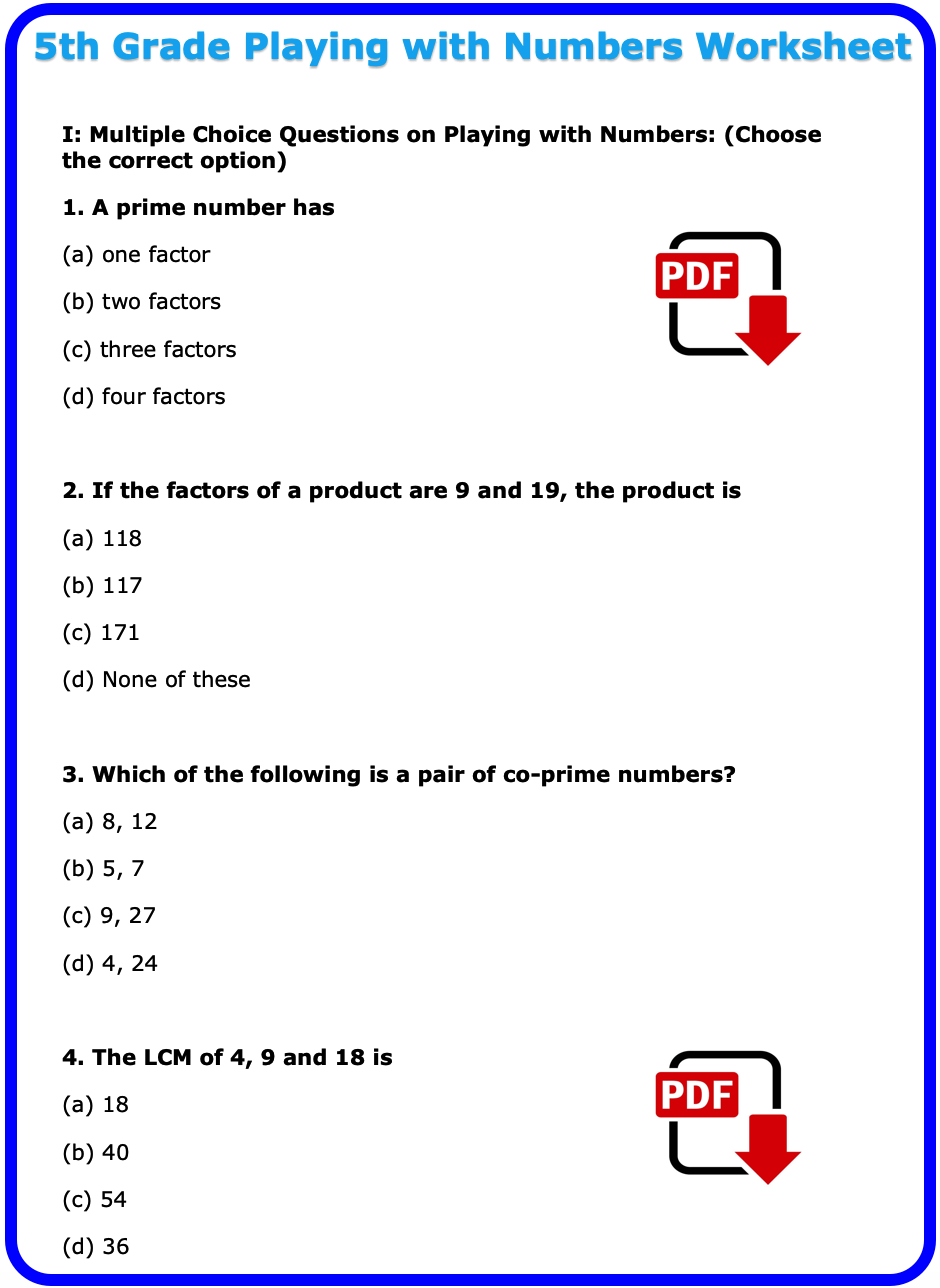
I: Multiple Choice Questions on Playing with Numbers: (Choose the correct option)
1. A prime number has
(a) one factor
(b) two factors
(c) three factors
(d) four factors
2. If the factors of a product are 9 and 19, the product is
(a) 118
(b) 117
(c) 171
(d) None of these
3. Which of the following is a pair of co-prime numbers?
(a) 8, 12
(b) 5, 7
(c) 9, 27
(d) 4, 24
4. The LCM of 4, 9 and 18 is
(a) 18
(b) 40
(c) 54
(d) 36
5. The HCF of 35 and 140 is
(a) 35
(b) 70
(c) 140
(d) None of these
6. The product of two numbers is 2160. If their HCF is 12, what is their LCM?
(a) 18
(b) 180
(c) 90
(d) None of these
7. Which of the following is a prime number?
(a) 88
(b) 89
(c) 91
(d) 99
8. If the number ✵4129 is divisible by 3, the value of ✵ is
(a) 1
(b) 2
(c) 3
(d) 4
9. Which of the following is completely divisible by 11?
(a) 12784
(b) 45353
(c) 443525
(d) 75365
10. The HCF of any two consecutive numbers is
(a) 1
(b) 2
(c) 3
(d) 4
11. The HCF of any two consecutive odd numbers is
(a) 1
(b) 2
(c) 3
(d) 4
12. The HCF of any two consecutive even numbers is
(a) 4
(b) 3
(c) 2
(d) 1
13. The HCF and LCM of two numbers are 61 and 3965 respectively. If one of the number is 305, the other number is
(a) 350
(b) 793
(c) 800
(d) 795
14. Which of the following is not a prime number?
(a) 19
(b) 29
(c) 39
(d) 59
15. Which of the following is not a pair of twin-prime numbers?
(a) 2, 3
(b) 3, 5
(c) 59, 61
(d) 71, 73
16. Which of the following is a multiple of 28?
(a) 1
(b) 4
(c) 28
(d) 55
17. The HCF of 6, 24 and 46 is
(a) 1
(b) 2
(c) 13
(d) 46
18. Which of the following is not divisible by 3?
(a) 7841
(b) 8417
(c) 59237
(d) 560319
19. The LCM of two numbers 774 and 828 is 35604. Their HCF is
(a) 2
(b) 6
(c) 14
(d) 18
II. Write all the factors of the following numbers:
(i) 45
(ii) 125
(iii) 729
III. Write the smallest odd composite number.
IV. Write the smallest and largest 4-digit numbers and determine the prime factorisation of each.
V. Find the HCF of the following by prime factorisation method:
(i) 48, 81
(ii) 347, 506
(iii) 69, 253
VI. Find the HCF of the following by the division method:
(i) 2628, 8541
(ii) 10549, 13563
(iii) 1197, 1311, 627
VII. A rectangular wall of size 11 m 20 cm and 9 m 60 cm is paved with square marble stones of the same size. Find the least number of marble stones required.
[Hint: HCF of 1120 and 960 = 160 (side of one stone),
Least no, of stones = \(\frac{1120 × 960}{160 × 160}\)
= 42]
VIII: Find the LCM of each of the following by prime factorisation method:
(i) 20, 36
(ii) 49, 63 and 84
(iii) 81, 126, 135 and 162
IX. Find the LCM of each of the following by division method:
(i) 12 and 32
(ii) 18, 60 and 72
(iii) 15, 18, 25, and 30
X. The HCF and LCM of two numbers are 161 and 3965 respectively. If one of the numbers is 305, find the other number.
XI. Fill in the blanks with the smallest digit to make each number divisible by 11:
(i) 304_5
(ii) 7_3593
(iii) 11_8220
(iv) 934_087.
XII. If a number is divisible by 2 and 7, will it be divisible by 14? Give an example.
XIII. Is 2430780 divisible by 7?

Answers:
I: 1. (b) two factors
2. (c) 171
3. (b) 5, 7
4. (d) 36
5. (a) 35
6. (b) 180
7. (b) 89
8. (b) 2
9. (b) 45353
10. (a) 1
11. (a) 1
12. (c) 2
13. (b) 793
14. (c) 39
15. (a) 2, 3
16. (c) 28
17. (b) 2
18. (c) 59237
19. (b) 6
II. (i) 1, 2, 3, 4, 6, 8, 12, 16, 24 and 48
(ii) 1, 5, 25 and 125
(iii) 1, 3, 9, 27, 81, 243 and 729
III. 9
IV. 1000; 9999; P1000 = 1, 2 and 5; P9999 = 1 and 3.
V. (i) 3
(ii) 1
(iii) 23
VI. (i) 657
(ii) 1507
(iii) 57
VII. 42
VIII: (i) 180
(ii) 1764
(iii) 5670
IX. (i) 96
(ii) 360
(iii) 450
X. 2093
XI. (i) 1
(ii) 0
(iii) 8
(iv) 9
XII. Yes; 28
XIII. No
From 5th Grade Playing with Numbers Worksheet to HOME PAGE
Didn't find what you were looking for? Or want to know more information about Math Only Math. Use this Google Search to find what you need.


